
Em geral, as grandes empresas não gastam menos com consultoria porque não percebem seu valor. O problema mais comum é que elas gastam muito em trabalhos que consideram importantes e, em seguida, gerenciam o total com menos disciplina do que aplicariam a outros investimentos de tamanho comparável.
Isso se deve, em parte, ao fato de a consultoria ainda ser tratada, em muitas organizações, como um custo a ser aprovado e não como um investimento a ser governado. Um projeto precisa de apoio externo, a justificativa é sólida, o orçamento é encontrado e o mandato segue em frente. Segue-se outro, depois outro, até que a empresa descobre que a consultoria foi comprada uma decisão de cada vez e financiada como se o total pudesse, de alguma forma, permanecer teórico.
Para CFOs, CPOs, diretores financeiros e gerentes de categoria, o problema não é saber se a consultoria é útil. Em muitos casos, ela é. A dificuldade é que as finanças e as compras são frequentemente solicitadas a controlar os gastos depois que as decisões reais já foram tomadas em outro lugar, por linhas de negócios, equipes de estratégia ou líderes de transformação. Eles, então, herdam a responsabilidade pelo controle exatamente no ponto em que seu espaço de influência é mais estreito, o que é uma maneira eficiente de transformá-los em guardiões depois que a parte interessante já passou.
É nesse ponto que as empresas mais bem administradas tendem a se diferenciar. Elas não tratam a consultoria como uma despesa necessária a ser tolerada, nem como uma despesa suspeita a ser lamentada posteriormente com precisão incomum. Elas a tratam como uma categoria de investimento: algo a ser priorizado, estruturado, obtido adequadamente e analisado em relação ao valor.
Essa é a mudança que o artigo explora e é também onde a Consource tem um lugar diferenciado na Procuretech: não adicionando mais uma camada de processo para que todos se ressintam, mas ajudando as empresas a gerenciar a consultoria desde a demanda até o sourcing e a entrega com mais visibilidade, mais continuidade e muito menos fé no impulso.
Por que a consultoria deve ser tratada como uma categoria de investimento
A consultoria entra nas grandes organizações porque alguém espera que ela melhore algo importante. Ela pode apoiar o crescimento, reduzir custos, acelerar uma transformação, gerenciar riscos, trazer conhecimentos especializados escassos ou ajudar a realizar um trabalho que a empresa não consegue executar com rapidez suficiente por conta própria. Em todos esses casos, o dinheiro está sendo gasto na expectativa de um efeito futuro. Essa já é a lógica do investimento, quer a empresa opte por descrevê-la dessa forma ou não. Para obter um detalhamento prático de como essa lógica se traduz em decisões de portfólio e disciplina de gastos, leia nosso guia para Maximizando o ROI da consultoria.
O retorno esperado nem sempre vem na mesma forma. Em alguns casos, é relativamente fácil identificá-lo, como no trabalho de eficiência ou na redução de custos. Na maioria das vezes, ele aparece de forma menos clara, por meio de uma execução mais rápida, melhores escolhas estratégicas, exposição reduzida ou recursos que a organização precisa, mas não pode desenvolver de forma sensata para cada problema que enfrenta. Nada disso garante valor, é claro. Muitos projetos de consultoria são vendidos com grande confiança e lembrados posteriormente com mais nuances. A questão é simplesmente que a categoria geralmente é justificada pelo que se pretende mudar, e não pelo fato de que pode ser reservada em algum lugar.
É nesse ponto que o tratamento usual se torna muito restrito. Se a consultoria deve afetar o desempenho, a direção, a velocidade ou o risco, então a questão importante não é apenas o custo. A questão mais séria diz respeito ao efeito que se pretende produzir e se vale a pena pagar por esse efeito. Normalmente, uma empresa não descreveria uma atualização de fábrica, um grande programa de sistemas ou uma aquisição estratégica puramente em termos de controle de despesas e depois esperaria que a discussão sobre o valor se resolvesse mais tarde. Muitas vezes, a consultoria tem se beneficiado exatamente desse nível de otimismo.
Isso é ainda mais importante em grandes empresas porque a demanda de consultoria raramente chega em um bloco coerente. Ela aparece por meio de projetos separados, equipes separadas, urgências separadas, cada uma com sua própria justificativa e, geralmente, com confiança interna suficiente para levar as coisas adiante. Portanto, o caso de investimento fica disperso por toda a empresa. O que parece razoável em nível de projeto ainda pode produzir uma má alocação de dinheiro em nível de portfólio.
Tratar a consultoria como um investimento não significa vestir o gasto comum com vocabulário estratégico e chamá-lo de transformação. Significa ser claro sobre o valor esperado, as alternativas disponíveis e o motivo pelo qual esse uso de suporte externo merece espaço à frente de outras reivindicações do negócio. Uma categoria desse porte deve ser capaz de sobreviver a esse nível de seriedade. Se não conseguir, o problema geralmente não é a governança.
O que as empresas da Fortune 500 fazem de diferente
As grandes empresas que gerenciam bem a consultoria não são necessariamente as que compram menos, nem as que têm o processo mais elaborado em torno da categoria. O que tende a distingui-las é uma ordem mais clara de decisões. Elas não começam com a empresa, o painel ou o projeto que chegou primeiro com energia interna suficiente para se tornar inevitável. Elas começam mais acima, com o portfólio, e vão descendo a partir daí.
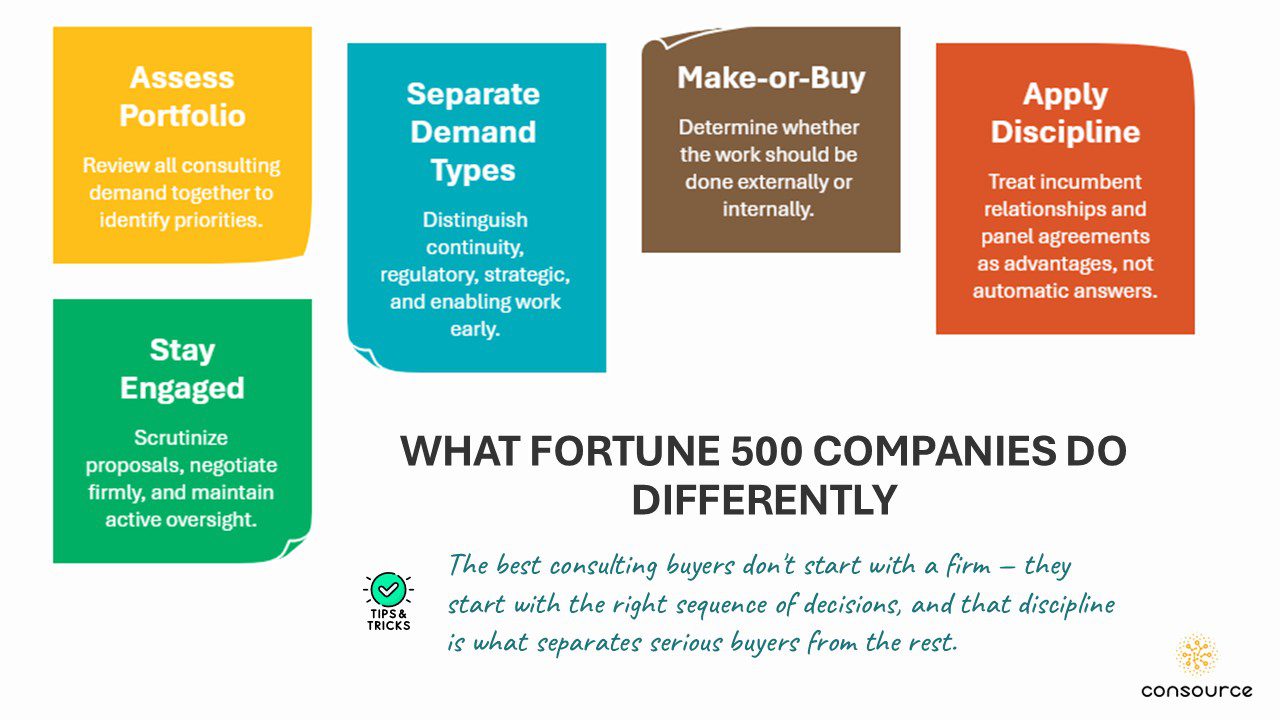
Eles começam com o portfólio
As organizações mais maduras não começam com o mercado fornecedor ou mesmo com o projeto individual. Elas começam com o portfólio. A demanda de consultoria é vista de forma agregada antes de ser tratada mandato por mandato, o que permite que a empresa decida o que é mais importante agora, onde o suporte externo é realmente justificado, onde os projetos se sobrepõem e onde várias solicitações individualmente razoáveis se somam a um padrão muito menos convincente.
Isso muda a ordem das decisões. A primeira pergunta não é quem deve fazer o trabalho, mas quais projetos merecem prioridade à luz dos objetivos atuais da empresa, das restrições e das demandas concorrentes. Só depois disso é que a discussão passa para o projeto em si, depois para as opções de entrega e, por fim, para o sourcing. As empresas que pulam a etapa do portfólio geralmente descobrem a disciplina mais tarde, quando os projetos já estão em andamento e o orçamento começou a adquirir uma reivindicação de continuidade bastante inconveniente.
Eles distinguem entre diferentes tipos de demanda de consultoria
As empresas mais disciplinadas não tratam todos os projetos de consultoria como se pertencessem à mesma categoria. O trabalho vinculado à continuidade dos negócios, à pressão regulatória, à eficiência operacional, à estratégia, à transformação e às iniciativas de capacitação mais amplas não cria valor no mesmo cronograma ou da mesma forma.
A continuidade dos negócios e o trabalho regulatório geralmente se protegem muito bem. Suas consequências são imediatas, legíveis e desagradáveis o suficiente para chamar a atenção. Os trabalhos de estratégia e transformação também têm maior probabilidade de sobreviver, em parte porque as grandes organizações os aceitam como usos respeitáveis de dinheiro sério. O que tende a enfraquecer sob pressão são os outros projetos de capacitação: cultura, engajamento dos funcionários, desenvolvimento de capacidades, fundamentos de dados ou partes da transformação digital cujo valor é real, mas menos obrigatório no curto prazo.
Quando esses projetos muito diferentes são submetidos à mesma lógica orçamentária, o resultado é previsível. O urgente sobrevive, o visível sobrevive e qualquer coisa que exija paciência começa a parecer ligeiramente opcional. É assim que uma empresa se mantém segura, estratégica e completamente subinvestida nas partes que teriam tornado os próximos anos menos incômodos. A dívida técnica se acumula sem precisar de muita aprovação, as lacunas de capacidade permanecem lealmente no lugar e o desgaste dos funcionários acaba retornando à agenda disfarçado de surpresa.
As organizações que gerenciam bem a consultoria são mais deliberadas em relação a isso. Elas separam essas formas de demanda desde o início porque sabem que diferentes tipos de valor não se saem igualmente bem quando a conversa é reduzida ao que pode se defender mais rapidamente.
Eles levam a sério a opção "fazer ou comprar
Outra diferença aparece antes do início do sourcing. As organizações mais fortes não passam diretamente de “isso é importante” para “qual empresa devemos chamar”. Elas perguntam se o trabalho deve ser feito externamente, se parte dele deve ser feito dentro da empresa e se o projeto exige um ou vários tipos de especialização.
Essa não é uma questão cerimonial. Em grandes empresas, a capacidade interna, a necessidade de especialistas, a velocidade e a conveniência política têm o hábito de se confundir, e às vezes a consultoria é solicitada a resolver um problema que é em parte estratégico, em parte operacional e em parte resultado de limites internos que ninguém está especialmente ansioso para mencionar na reunião. As empresas que otimizam bem a consultoria estão mais dispostas a resolver isso antes do início do processo de sourcing.
Eles são mais seletivos no fornecimento
Uma vez que o projeto e o modelo de entrega estejam claros, as empresas mais bem administradas são menos informais na escolha das empresas. Elas sabem o valor dos relacionamentos com os operadores históricos e sabem o valor da concorrência, o que é uma combinação mais útil do que parece.
As empresas conhecidas geralmente têm vantagens reais. Um consultor que já entende o negócio, os hábitos de tomada de decisão, a política interna e as restrições do ambiente operacional deve ser capaz de realizar um trabalho útil mais rapidamente e com uma redescoberta menos dispendiosa. Se isso não acontecer, o cliente pode ter um problema de consultoria em vez de um problema de sourcing. Os painéis também podem fazer sentido por motivos práticos: eles geralmente oferecem melhores termos comerciais, mobilização mais fácil e um grau de familiaridade mútua que reduz o atrito quando o trabalho é delicado ou urgente.
A dificuldade começa um pouco mais tarde, quando esses pontos fortes são tratados como uma resposta suficiente para cada novo mandato. Uma empresa pode conhecer bem o ambiente e ainda assim não ser a escolha certa para um problema específico. Um painel pode criar eficiência e, ainda assim, limitar o campo de atuação de forma muito confortável. É nesse ponto que as organizações maduras são mais disciplinadas. Elas tratam a familiaridade, a velocidade e os termos negociados como vantagens relevantes, mas ainda perguntam se o conhecimento especializado, o escopo e o modelo de entrega são adequados para o trabalho em questão.
A forma como as organizações estruturam e atualizam seus painéis faz uma diferença significativa - um tópico abordado em profundidade em nosso guia para Criação e otimização de seu painel de provedores de consultoria.
Eles mantêm o foco após a seleção do fornecedor
As melhores organizações não tratam a seleção de fornecedores como o fim da parte interessante, porque a seleção é apenas um estágio em um julgamento muito maior. Antes de iniciar o trabalho, elas analisam atentamente o que está sendo proposto: o modelo de pessoal, o nível de senioridade, a abordagem de entrega, a duração, a estrutura de preços e as suposições que sustentam tudo isso. Nada disso é mecânico. É uma equação bastante complexa, e as melhores empresas estão preparadas para negociá-la seriamente. Elas sabem quando algum compromisso é sensato, quando a visão de um consultor reflete uma restrição real de entrega e quando a firmeza é necessária porque a proposta se tornou generosa em todos os pontos que afetam os honorários. Uma estrutura estruturada para avaliação de propostas de consultoria em relação aos critérios de ROI torna esse julgamento consideravelmente menos dependente do instinto e consideravelmente mais difícil de ser manipulado.
Essa mesma disciplina continua quando o projeto está em andamento. As organizações mais fortes não presumem que a assinatura do contrato tenha resolvido a questão em qualquer sentido significativo. Elas se certificam de que os consultores entregam o que foi prometido, mas estão igualmente atentas à equipe interna do projeto, porque os projetos de consultoria não fracassam exclusivamente do lado de fora. As mudanças de escopo são rastreadas, os compromissos são revisados e o trabalho é revisado com continuidade suficiente para que o pagamento reflita o que é realmente devido e não o que a passagem do tempo conseguiu normalizar.
Geralmente é aí que a diferença aparece. Muitas empresas se tornam altamente processuais no momento da compra e nitidamente filosóficas quando a entrega começa. As melhores empresas permanecem engajadas por mais tempo, o que é útil em uma categoria em que “todos nós entendemos da mesma forma” costuma ser uma verdade muito temporária.
Onde o Consource se encaixa
Entender que a consultoria deve ser gerenciada como um investimento é uma coisa. Fazer isso de forma consistente é outra. Na maioria das organizações, o processo permanece disperso. A demanda é discutida em um lugar, o sourcing em outro, o acompanhamento do projeto em outro e, no momento em que alguém quer ter uma visão coerente do que foi solicitado, aprovado, entregue e aprendido, a resposta está espalhada por sistemas, equipes e vários documentos que parecem finais até serem comparados uns com os outros.
Da demanda à entrega
O Consource é útil porque começa onde a decisão de consultoria realmente começa. Antes de haver uma RFP, antes de haver um fornecedor preferencial, há um projeto que pode ou não merecer apoio externo e um portfólio no qual esse projeto pode ou não merecer prioridade. Esse é o momento em que os gastos com consultoria ainda podem ser moldados de forma significativa. Quando o projeto já está em andamento, a formalidade aumenta e o espaço para julgamento diminui.
É também por isso que a plataforma é importante além da aquisição. Em muitas empresas, a consultoria é iniciada por líderes de negócios, partes interessadas em finanças, equipes de estratégia ou funções de transformação que conhecem bem o problema e compram suporte externo com métodos muito irregulares. A Consource traz estrutura para esse estágio sem exigir que todas as decisões desapareçam em um processo central governado pelo setor de compras.
Gerenciamento da demanda em nível de portfólio
A visão do portfólio é importante porque a demanda de consultoria não se apresenta em uma fila ordenada. Ela se acumula em unidades de negócios, prioridades e urgências, todas com argumentos a seu favor e algumas até mesmo merecendo-os. Sem uma visão de portfólio, cada projeto pode parecer razoável por si só, enquanto o padrão geral se torna cada vez menos convincente.
O Consource ajuda a tornar esse padrão visível. Quais projetos estão surgindo, quais merecem espaço agora, quais se sobrepõem, quais pertencem a um modelo de entrega diferente e quais estão sobrevivendo principalmente porque ninguém ainda teve o prazer de compará-los com os demais. Essa é a diferença entre ver a consultoria como uma sequência de projetos e vê-la como uma categoria de opções de investimento.
Estruturação de decisões de sourcing
Uma vez tomada a decisão de usar o suporte externo, a parte difícil não é encontrar consultores dispostos a responder. É decidir que tipo de trabalho está realmente sendo comprado, que escopo faz sentido, que modelo de equipe é confiável, se uma empresa deve fazer todo o trabalho e como as propostas devem ser comparadas sem confundir familiaridade, confiança e adequação.
É nesse ponto que o Consource é realmente útil. Ele ajuda a estruturar o próprio processo de sourcing: o briefing, a RFP, a comparação de propostas, a lógica da escolha do fornecedor e a discussão comercial que se segue. Em uma categoria em que uma proposta pode parecer perfeitamente sensata e, ao mesmo tempo, esconder várias suposições caras à vista de todos, essa estrutura faz um trabalho real.
Orientação das partes interessadas em todo o processo
O Consource também ajuda a resolver um problema que muitas organizações conhecem bem e discutem com menos franqueza. Espera-se que o setor de compras traga disciplina, mas a empresa geralmente quer velocidade, e a consultoria é frequentemente obtida por partes interessadas que não fazem parte do setor de compras. O resultado é um processo no qual a autonomia sobrevive, mas nem sempre em uma forma que melhore a decisão de compra.
O valor da plataforma é que ela oferece suporte a ambos os lados. O setor de compras ganha mais visibilidade e mais poder de influência. As partes interessadas da empresa mantêm a capacidade de se movimentar, mas com mais orientação e consistência do que normalmente produziriam por conta própria. Sem esse equilíbrio, o setor de compras se torna um gargalo ou a empresa se torna improvisada, e nenhuma dessas abordagens tem um histórico especialmente distinto.
Manter o controle após a seleção do fornecedor
A mesma lógica continua depois que o contrato é assinado. Um melhor gerenciamento de consultoria não termina com a escolha da empresa. A entrega, a evolução do escopo, o desempenho do fornecedor, o acompanhamento do projeto e o encerramento afetam a sobrevivência do caso de investimento original ao contato com a realidade. Muitas organizações são muito atentas durante o sourcing e nitidamente mais filosóficas após o início do trabalho.
O Consource mantém esses estágios conectados. A empresa pode acompanhar o que foi proposto, o que foi acordado, o que mudou, o que foi entregue e o valor que surgiu. Essa continuidade é importante porque possibilita o aprendizado. Sem ela, cada novo projeto de consultoria começa com menos inteligência acumulada do que a categoria já pagou.
Por que isso é importante na Procuretech
É nesse ponto que o Consource tem um lugar mais distinto. Muitas ferramentas de Procuretech são úteis para o fluxo de trabalho, as aprovações, os contratos e a visibilidade dos gastos. A consultoria exige algo anterior e mais específico: uma maneira de gerenciar a demanda, a lógica de sourcing, a qualidade da proposta, a adequação do fornecedor e o acompanhamento do projeto como partes da mesma cadeia de decisões.
Esse é o espaço que o Consource atende. Ele oferece às partes interessadas de finanças, compras e negócios uma maneira de gerenciar a consultoria com mais continuidade, mais disciplina e muito menos dependência da vontade individual de fazer a coisa certa.
O que isso significa para CFOs, CPOs, gerentes de categoria e diretores financeiros
A mesma categoria pode parecer muito diferente, dependendo da posição de cada um. A consultoria é estratégica para a empresa, comercial para o setor de compras, financeira para o CFO e, ocasionalmente, as três coisas ao mesmo tempo, o que explica por que a conversa pode se tornar muito corrida. As empresas que gerenciam bem a consultoria não resolvem isso fingindo que todos querem a mesma coisa. Elas resolvem isso atribuindo a cada função um papel mais claro antes que o projeto se torne comprometido demais para ser discutido honestamente.
Para CFOs e diretores financeiros
Para CFOs e diretores financeiros, a conversa útil começa durante o ciclo orçamentário, quando a demanda de consultoria ainda pode ser comparada com outras reivindicações de capital e atenção da gerência. Esse é o momento de decidir quais projetos merecem espaço, que tipo de retorno é esperado e quanto da categoria está sendo impulsionado pela necessidade estratégica e não pelo hábito, pela urgência ou pela persistência silenciosa de padrões de gastos anteriores. Se o setor financeiro entrar apenas quando um projeto estiver pronto para aprovação, a função se restringe rapidamente. Torna-se mais fácil validar os gastos do que influenciar por que eles existem, por que assumem essa forma ou por que devem ser feitos antes de qualquer outra coisa. desafios na aquisição de consultoria - e um dos mais difíceis de corrigir quando o projeto já ganhou impulso.
Para CPOs e gerentes de categoria
As equipes de compras e de categorias estão mais próximas do mercado, o que deveria ser uma vantagem, embora muitas vezes seja exercida sob condições que não são especialmente generosas. No momento em que eles são trazidos, o projeto já pode ter sido moldado, o provável perfil do fornecedor compreendido e o apetite interno por comparação visivelmente mais fraco do que os slides podem sugerir.
As organizações que fazem isso bem dão à aquisição um papel mais útil. Os gerentes de categoria podem contribuir onde agregam mais valor: ajudando a moldar a estratégia de sourcing, testando se o escopo é sensato, julgando quando a concorrência pode melhorar o resultado e garantindo que os termos do acordo reflitam a realidade do trabalho e não o otimismo da proposta. Isso é mais interessante do que ser solicitado a negociar tardiamente e depois absorver a decepção quando o preço acaba sendo associado à substância.
O que muda quando a conversa começa cedo
As organizações mais eficazes incluem finanças, compras e, muitas vezes, estratégia na discussão antes que o projeto esteja muito avançado para ser moldado adequadamente. É nesse momento que o orçamento esperado, o valor provável e a estratégia de sourcing ainda podem ser discutidos juntos, e não em sequência, com cada função chegando tarde o suficiente para herdar as suposições de outra pessoa.
O setor de compras raramente tem autoridade para decidir por conta própria quais projetos merecem ser levados adiante. O setor financeiro tem a lente da alocação, mas não o conhecimento de sourcing ou de mercado para julgar a estratégia sem ajuda. As equipes de estratégia e transformação geralmente estão mais próximas da questão de quais projetos são mais importantes, mas nem sempre são os melhores juízes de como o suporte externo deve ser estruturado ou comprado. A categoria só se torna mais gerenciável quando essas perspectivas são reunidas antes que o projeto se transforme em uma solução preferida com um orçamento anexado.
A empresa decide com antecedência quais projetos devem prosseguir, que tipo de ajuda externa eles realmente precisam e como essa ajuda deve ser adquirida antes que o processo se torne um exercício de endossar uma conclusão já alcançada em outro lugar.
Conclusão
As grandes empresas não obtêm melhor valor da consultoria tratando-a como um custo a ser aprovado com um pouco mais de cuidado. Elas obtêm melhor valor quando decidem antecipadamente quais projetos merecem apoio externo, que tipo de apoio eles realmente precisam e como esse apoio se encaixa no restante do portfólio.
É isso que as empresas mais maduras fazem de forma diferente. Elas não presumem que todo projeto urgente merece consultoria, que toda empresa conhecida merece outro mandato ou que a aprovação do orçamento é a mesma coisa que disciplina de investimento. Elas fazem escolhas mais claras com antecedência e continuam prestando atenção depois que o contrato é assinado, o que é um hábito mais raro do que a categoria merece.
É também nesse ponto que o Consource se encaixa. Ele ajuda a dar continuidade a um processo que, com muita frequência, é fragmentado entre demanda, sourcing, entrega e revisão, e oferece às partes interessadas de finanças, compras e negócios uma maneira de governar a consultoria com menos improvisação e menos dependência da vontade individual de fazer a coisa certa.
A consultoria sempre envolverá julgamento. O problema não é o fato de as empresas a utilizarem. O problema é que muitas ainda a gerenciam como se o investimento estratégico e o gasto acumulado fossem ideias praticamente intercambiáveis.
Reserve um passo a passo gratuito do Consource.io e veja como seus gastos com consultoria podem ser gerenciados com mais visibilidade, mais disciplina e melhores resultados.
Perguntas frequentes
Como as empresas da Fortune 500 otimizam seus gastos com consultoria?
Por que as grandes empresas devem tratar a consultoria como um investimento e não como um custo?
Onde o setor de compras normalmente perde influência no processo de sourcing de consultoria?
Em geral, o setor de aquisições é acionado depois que o projeto já foi moldado, o provável fornecedor é informalmente conhecido e o apetite interno por uma comparação genuína enfraqueceu. Nesse ponto, as decisões que geram mais valor - qual escopo é realmente necessário e que tipo de fornecedor é adequado para o trabalho - já foram tomadas, deixando pouco espaço para influenciar o que o gasto acaba proporcionando.
Como a má governança de consultoria afeta os CFOs e os diretores financeiros?
Quando o financiamento é trazido apenas quando um projeto está pronto para aprovação, o papel se reduz a endossar uma decisão já tomada em outro lugar. O problema mais profundo é que a governança deficiente significa que a demanda de consultoria raramente é questionada no nível certo - os projetos individuais não são testados quanto à sua justificativa e o portfólio total não é avaliado honestamente em relação a outras categorias de investimento que competem pelo mesmo capital.




0 comentários