
The consulting tail — conventionally defined as the bottom 20% of consulting expenditure by transaction value — has a reputation problem. The name implies that it is residual, trailing, and probably manageable. The reality, for most large organisations, is that it represents somewhere between 20% and 25% of total consulting spend, receives a fraction of the governance attention directed at larger mandates, and is understood, at best, in outline. This is not a niche procurement problem. It is a material exposure that most organisations have simply decided to tolerate.
What follows draws on our full insight on tail spend management — How to manage the tail spend — but focuses on four areas where the standard advice tends to stop short of what is actually useful. Before getting there, one diagnostic observation is worth making, because the way you define the tail determines everything that follows.
The first thing to establish: how much of your tail is actually tail
There is a concept in consulting procurement that deserves more attention than it typically receives: the false tail. It refers to the portion of apparent tail spend that is not genuinely small — not because the individual transaction values are large, but because the underlying projects are not the isolated, low-stakes engagements they appear to be.
The false tail takes several forms. Some projects are recurring: a pulse survey, a benchmarking exercise, a voice-of-the-customer assessment run every year by a different team, each time treated as a new one-off engagement with no supplier continuity, no consolidated negotiation, and no category-level view of what the organisation is actually spending on that activity. Some are duplicates: the same work commissioned independently by two business units who were not aware of each other’s plans, sometimes by the same consultancy. And some are what might be called never-ending sequels — projects that have, in practice, no end date, but which are structured as a sequence of short mandates to stay beneath a threshold that would otherwise require more scrutiny. A project in its fourth phase, each phase conveniently priced at €48,000 against a €50,000 threshold, is not tail spend. It is a managed engagement with an unexamined governance structure.
The implication is that before any attempt is made to manage the tail, it is worth establishing what proportion of it is genuinely small and genuinely discrete, and what proportion is the false tail. The two populations require entirely different responses: one calls for simplified sourcing with light-touch oversight; the other calls for the same structured approach you would apply to any significant engagement. Treating them identically — which is what most organisations do, by default — is how recurring projects stay permanently undercontracted and how large sequential mandates continue to avoid the scrutiny they would otherwise attract.
A quick diagnostic: Do projects in your organisation regularly land just below your main procurement threshold? Do you have the same suppliers appearing repeatedly in small-project spend without a formal framework agreement? Are there activities — surveys, diagnostics, benchmarking exercises — that you commission every year without a consolidated contract? If the answer to most of these is yes, a meaningful share of what you are calling tail spend is not tail spend, and the management response is correspondingly different.
Not sure where your organisation stands? Use our free self-diagnostic checklist to score your consulting tail spend infrastructure in five questions. Download the Consulting Tail Spend Checklist
Four practices that are actually worth the effort
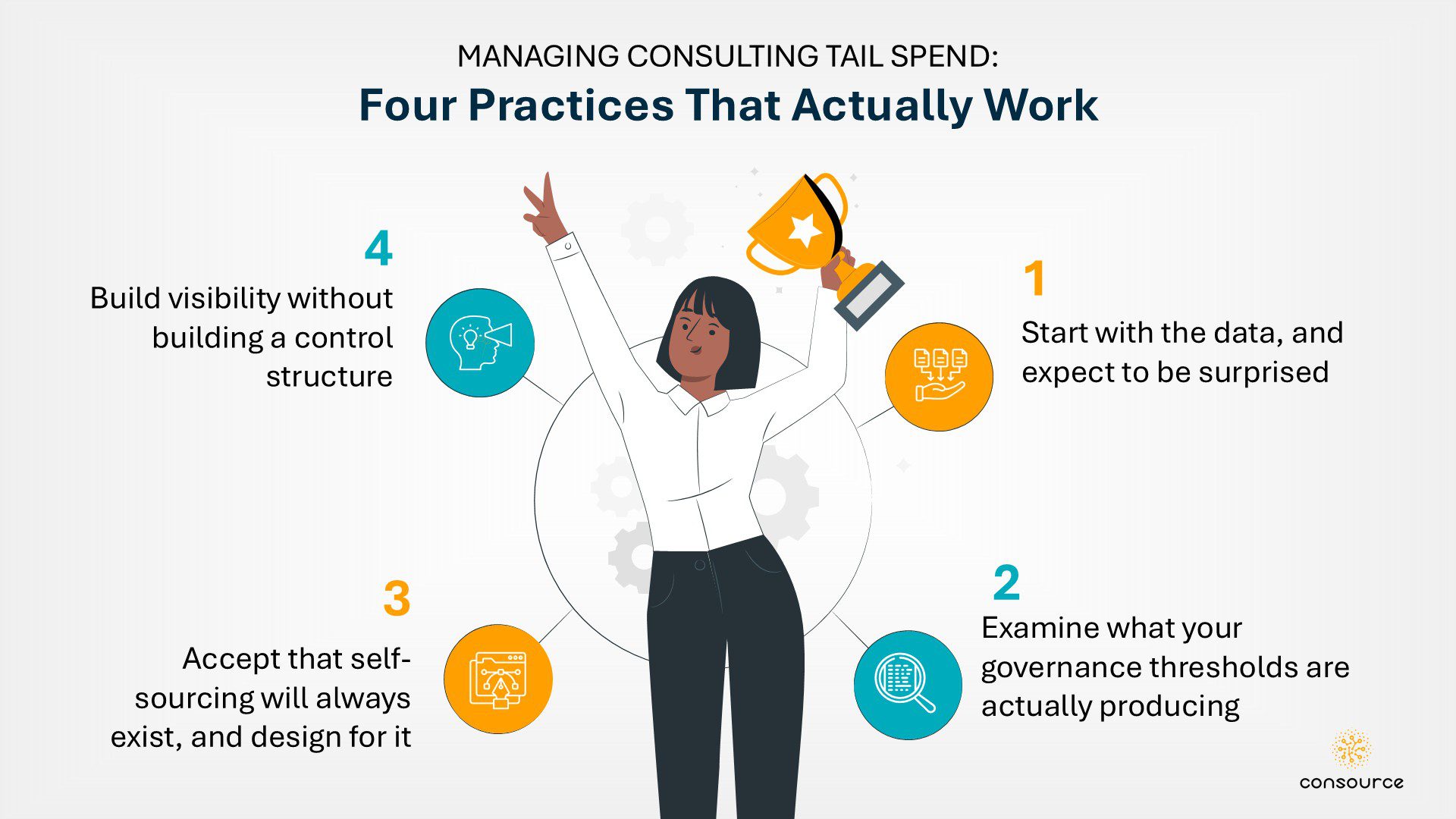
1. Start with the data, and expect to be surprised
Any attempt to manage consulting tail spend runs immediately into an inconvenient prior question: what is actually in the category? This sounds like an administrative detail. It is not. In organisations where spend classification is decentralised, the consulting category tends to accumulate a significant proportion of expenditure that has no plausible claim to being consulting. In some cases we have encountered, more than 40% of what sits in the consulting budget is something else — IT maintenance contracts filed under management consulting, business process outsourcing bundled with advisory fees, and, on one occasion, a fishmonger in Moissac, France, who had found his way into the professional services budget through a chain of reclassifications that no one had subsequently reviewed.
The fishmonger is memorable, but the more common problem is subtler: the genuine difficulty of drawing a consistent line between consulting, external services, and BPO in organisations where the people doing the classification are operational teams applying local conventions. This is not malice and rarely even carelessness. It is a structural consequence of decentralisation, and it means that any spend analysis conducted without a data cleaning step is an analysis of the wrong population.
The practical starting point, then, is a spend classification exercise — identifying what actually belongs in the consulting category, re-coding what does not, and establishing a taxonomy that can be applied consistently going forward. The effort is not small, and it rarely produces exciting headlines. What it produces is a baseline you can actually work from, which turns out to be a prerequisite for everything else.
Once the data is clean, spend analysis yields a picture with three components worth examining separately: the composition of the tail (how many suppliers, what types of projects, what concentration by business unit), the performance of the providers in it (which requires conversations with project sponsors, since the data alone will not tell you this), and the size of the prize — the realistic savings potential net of the effort required to capture it. Depending on the organisation’s starting point, that figure can range from 5% to 40% of tail spend. The variance is large enough that it is worth estimating before committing significant resources to the exercise.
If you are looking to take control of your consulting spend, read how business leaders are doing it — Pare de desperdiçar milhões: Como os líderes empresariais podem assumir o controle dos gastos com consultoria
2. Examine what your governance thresholds are actually producing
Most organisations have tiered procurement thresholds — a level below which a lighter process applies, and above which a more structured one kicks in. The design intent is sensible: apply proportionate governance to proportionate spend, and avoid creating bureaucratic friction for small decisions. What this design produces in practice is a reliable density of projects priced just below whatever the threshold is. People are not, in the main, doing anything improper. They are responding rationally to incentives that the governance architecture has put in front of them.
The consequence is that a share of the consulting work that would benefit from a competitive process does not receive one — not because it was explicitly excluded, but because the budgeting was done with the threshold in mind. This is distinct from the false tail problem described above, though it often overlaps with it: a never-ending sequel and a threshold-hugging budget frequently coexist in the same project.
Redesigning thresholds for the consulting category specifically — rather than applying a generic indirect procurement policy — addresses part of this. Equally important is making the process above the threshold fast enough that staying below it is not the obvious rational choice. A competitive process that takes six weeks for a €150,000 mandate will always lose to an autonomous decision. One that takes ten days, supported by a pre-qualified supplier panel and a lightweight briefing template, changes the calculation materially. The goal is not to eliminate the threshold but to reduce the premium attached to staying beneath it.
The demand management approach worth considering here is a dedicated budget envelope for small projects: a pre-allocated amount at departmental level that business units can draw on autonomously, without full procurement protocols, but within defined limits and with a restricted supplier list. This preserves the flexibility that business units legitimately need while containing the exposure. It works best when the envelope amount is calibrated to actual historical spend rather than set arbitrarily, and when the supplier list attached to it is genuinely fit for purpose — which requires, at minimum, that the suppliers have been qualified and that their rates have been benchmarked.
3. Accept that self-sourcing will always exist, and design for it
There is a version of consulting tail spend management that aims, ultimately, to channel everything through a centralised procurement process. It is a coherent ambition. It is also not going to happen, and not principally because of organisational resistance. It is not going to happen because executive autonomy over small consulting engagements is a legitimate operating need. The ability to commission a focused piece of work quickly, without navigating a full procurement cycle, is part of how organisations function. Eliminating it would create more disruption than the tail spend it is trying to address.
The productive question is not how to capture all self-sourced spend but how to make self-sourcing less risky and less costly when it occurs. Procurement cannot be involved in every small project; the bandwidth does not exist and the value added would not justify it. But procurement can design the conditions under which business units source autonomously and produce acceptable outcomes.
This means, in practice: a panel of pre-qualified suppliers that stakeholders can access directly, without a competitive process, for engagements beneath a defined threshold — where qualification has already done the vetting work, rates have been negotiated at the panel level, and the only remaining decision is which supplier to engage for which type of work. It means rate guidance that gives non-procurement buyers enough market context to know when a proposed fee is reasonable. And it means a lightweight digital workflow — fast enough to compete with the informal email chain that is the current alternative — that captures the engagement in the system without requiring expertise to operate.
The framing that tends to work with business unit heads is not control but guidance: the panel and the process exist to make their sourcing decisions faster and safer, not to create a new layer of approval. Preferred supplier programmes that are structured this way — with genuine choice, real pre-negotiated rates, and a process that does not add delay — tend to achieve meaningful adoption. Those that are structured primarily as control mechanisms tend to produce the workarounds they were designed to prevent.
Not sure where to start with your consulting tail? This episode of Smart Consulting Sourcing breaks down exactly how to identify, categorize, and act on it — Tackle the Tail Spend in Consulting
4. Build visibility without building a control structure
Consulting spend is distributed across departments, entities, and geographies in a way that makes a consolidated view structurally difficult to achieve. The tail is the most distributed part of this distributed category: small amounts, multiple cost centres, minimal tracking. The result, in most organisations, is that procurement has a reasonably accurate picture of the large mandates and a very partial picture of everything below a certain size — which is, unfortunately, the segment where fragmentation is highest and where the data problems described above are most acute.
The standard response to fragmented visibility is centralisation of purchasing authority. The difficulty with this response, as described above, is that it removes flexibility that business units legitimately need, and tends to produce compliance theatre — formal adherence to the process accompanied by informal workarounds that render the data meaningless. Centralised authority and accurate data do not, in practice, reliably coexist.
The more effective approach is to centralise the information without centralising the decisions: a single platform through which all consulting engagements — whether managed by procurement or sourced autonomously by business units — are recorded, classified, and tracked. This gives procurement the consolidated view it needs to manage the category at a portfolio level, identify where the false tail is building up, spot supplier concentration risks, and benchmark rates across the organisation, without requiring that every decision flow through a central team. The visibility and the control are separated, which turns out to matter quite a lot for adoption.
To understand why most CFOs still lack this visibility and what to do about it, read — The CFO’s Blind Spot: Why You Still Don’t Know Where Your Consulting Budget Goes
Onde o Consource se encaixa
The four problems above — unreliable data, threshold-driven distortion, unmanaged self-sourcing, and fragmented visibility — are not independent. They are produced by the same underlying condition: consulting spend managed with tools designed for other categories, by organisations that have not distinguished between the specific dynamics of consulting and the rest of indirect procurement. Generic procurement platforms do not have a consulting taxonomy, do not have rate benchmarking calibrated to the consulting market, and do not have the supplier qualification workflows that make a preferred panel genuinely usable rather than nominally present.
Consource is designed specifically for the consulting category. Spend flowing through the platform is classified against a consulting-specific taxonomy from the point of entry, which eliminates misclassification at source rather than requiring it to be corrected in analysis. Tiered sourcing workflows — a rapid competitive process for small mandates, a structured RFP for larger ones — are calibrated to the consulting market, which reduces the friction premium that currently attaches to staying beneath the threshold. Pre-qualified supplier panels are accessible directly by business units for autonomous sourcing, with negotiated rates and embedded guidance, so self-sourcing produces compliant outcomes without procurement involvement in every transaction. And all of this — managed and self-sourced, large and small — is visible in a single consolidated view, which is the precondition for any serious category management of the tail.
The tail does not become manageable because you have better intentions about managing it. It becomes manageable when the infrastructure makes management possible.
See how Consource.io gives you instant visibility into your consulting tail — book a 30-minute walkthrough.




0 comentários