
Most discussions of procurement automation begin with the wrong inefficiencies. The visible ones, which take the form of approvals that run five days when they could run one, purchase orders that pass through three signatories when one would do, and supplier onboarding paperwork nobody quite remembers designing, receive a disproportionate share of executive attention, partly because they are easy to describe and easier still to fix. The inefficiencies that genuinely cost organisations money in consulting procurement are quieter, and they are almost never on the slide that justifies the next software investment.
What matters here is precision: knowing exactly what is being automated and why, a case made more fully in Why Traditional Consulting Procurement Is Broken, and How Digital Fixes It. Automation that compresses a five-day approval into one day saves time, which is a different achievement from giving an organisation a real-time view of consulting spend across the enterprise, and the difference matters more in consulting than in almost any other category. This article is part of our broader exploration of how AI is reshaping consulting sourcing; here we focus specifically on the inefficiencies that automation can resolve, the inefficiencies it cannot, and how procurement leaders might tell the difference before signing the next contract.
What procurement automation tools actually do well
It is worth giving mainstream procurement automation the credit it deserves before complicating the picture. Workflow automation has genuinely improved the operating rhythm of most procurement functions. Approvals that used to circulate by email, accumulating delays at every desk they passed, now move through structured workflows with timestamps, escalation paths, and audit trails that make accountability less negotiable than it once was. The shift is not glamorous, but it is real, and the cycle-time reductions are measurable.
RFP management tools have produced similar gains. The mechanics of issuing a request, collecting responses, comparing line items, and producing a defensible recommendation no longer require the cottage industry of spreadsheets and shared folders that the discipline relied on for a decade. Contract lifecycle management platforms have done much the same for the post-award stage, surfacing renewal dates, tracking obligations, and reducing the number of agreements that quietly extend themselves because nobody remembered to look at them in time. Supplier onboarding, e-invoicing, and three-way matching have each been meaningfully improved by tools that did not exist in their current form ten years ago, part of a wider set of digital procurement trends transforming consulting procurement.
The administrative burden on procurement teams has shrunk as a result, and the audit trail has become more defensible. These are not trivial outcomes. In categories where the work is largely transactional, indirect goods, MRO, simple services, they may be most of what a procurement function needs.
Procurement automation tools, in their standard form, address process inefficiency, the friction in how procurement work gets done. For a fuller comparison of how digital and traditional procurement approaches differ across the function, read this article.
Process inefficiency is not, however, where consulting procurement loses money. The category has a different problem, and it does not respond to the same instruments.
Consider what actually happens in a large organisation. Consulting work is initiated by business units, strategy teams, finance leaders, transformation offices, and occasionally by procurement itself, each operating with reasonable autonomy and limited visibility into what the others are doing. The decision to engage external support is rarely a single decision; it is a series of small decisions taken at different moments by different people, and the structural cost of that fragmentation is what standard automation does not touch.
That fragmentation begins with information asymmetry. The consultant arrives at the negotiation with a view of the market, a memory of every comparable engagement they have priced, and a sense of how much the client is willing to pay. The client arrives with a view of one project. That asymmetry survives almost every procurement process that does not actively close it, and it shows up in scopes that are slightly too broad, staffing that is slightly too senior, and rates that nobody quite has the data to challenge.
It compounds through spend fragmentation, because the same firm is often retained simultaneously by three or four parts of the same enterprise, on engagements that may overlap, complement, or quietly duplicate one another. Each engagement is reasonable in isolation, but the aggregate is rarely defensible, and the aggregate is what the organisation is actually paying. Standard automation captures each transaction faithfully and tells you very little about the pattern.
What makes both harder to correct is performance memory loss. A consulting engagement concludes, the team disperses, and the institutional knowledge of how the firm actually performed, measured by whether their work was useful, whether their juniors were credible, whether their estimates held, leaves the organisation along with the people who managed the project. Six months later, the next engagement begins with the same firm, and the conversation has to start from scratch.
And underneath all three sits the relationship-driven default, because consulting flows through trust: a partner the business already knows, a firm that has done credible work before, a senior figure who returns calls quickly, these are real advantages, and pretending otherwise would be naive. The difficulty is that familiarity has a way of replacing comparison entirely, and the discipline of testing whether the familiar choice is actually the right choice for the current problem tends to weaken under time pressure.
The visibility gap: why these frictions don’t show up as inefficiencies
Considered together, these constitute what we call the visibility gap: the set of inefficiencies that do not show up as inefficiencies because nobody has the data to recognise them as such. This friction lives in the decision itself, in the judgement calls about which firm to trust and how much to pay, which is what makes it more expensive and considerably harder to automate away than the workflow steps standard automation targets.
This gap persists because the visibility that would close it belongs to no one’s job description: procurement is measured on cycle time, not portfolio pattern, so the people positioned to build the aggregate view are never the ones asked to explain why it doesn’t exist.
These structural information deficits are what the rise of AI and automation in consulting procurement is fundamentally trying to address; the question is whether the tools available actually close them.
Automated sourcing processes built for consulting procurement
If standard automation addresses process inefficiency and not the visibility gap, then the relevant question becomes what category-specific automation might look like for consulting. The answer has less to do with workflow design than with the relationship between the tool and the category itself, one part of a broader shift covered in 12 digital transformation dynamics shaping consulting procurement.
That relationship starts with spend taxonomy and aggregation. Consulting spans several categories, strategic, operational, regulatory, technology, transformation, and within each, the work carries different ROI logic, different supplier markets, and different price structures. A tool that treats it all as generic services spend produces a spreadsheet that is technically complete and analytically useless, whereas a tool that understands the category produces a view in which a CFO can see, in real time, which families of consulting work are growing, which firms are accumulating share across business units, and where the aggregate has drifted away from the original allocation. That single capability changes the conversation finance can have with the business.
That view only holds if the panel behind it reflects reality, which is what panel intelligence provides: a living, ranked supplier panel built from actual performance rather than the order in which firms happened to be added to the list. Most consulting panels are static, assembled at some point after a competitive process that produced reasonable choices at the time, and then used until somebody noticed that the same three firms were winning every mandate. A living panel updates performance data, sector fit, current capacity, and pricing benchmarks continuously, so that the question of which firm to invite for which project becomes an informed choice rather than a habit.
Choosing the right firm still leaves the question of what happens once the engagement starts, which is where project-level governance integration matters. Standard automation captures the contract. Category-specific automation captures the project, the scope as defined, the scope as it evolved, the deliverables as agreed, and the deliverables as actually produced. The distinction sounds technical, but it determines whether the organisation has the data to challenge a renewal six months later, or whether it has to rely on memory and goodwill.
That data is only available if someone captures it at the moment it still exists, which is the role of performance capture at engagement close. The moment immediately after a project ends is the only moment when the people who managed it remember clearly what worked and what did not. A tool that captures structured feedback at that moment, from the sponsor, from the project team, from the firm itself, builds an asset that compounds. A tool that does not capture it loses the data forever, and the next engagement begins blind. Cross-engagement performance data is one of the most underutilised levers in consulting sourcing.
Each of these capabilities is useful in isolation, but the compounding effect, cross-engagement learning, appears only when they are connected: the aggregate spend view informs the panel composition, the panel informs the sourcing choice, the sourcing choice generates project-level data, and the project-level data feeds back into the aggregate spend view. That feedback loop is the difference between a procurement function that gets smarter every year and one that processes the same volume of work with marginally less friction.
For a structured evaluation framework, see What to Look for in a Consulting Procurement Platform.
How procurement leaders evaluate automation tools for consulting spend
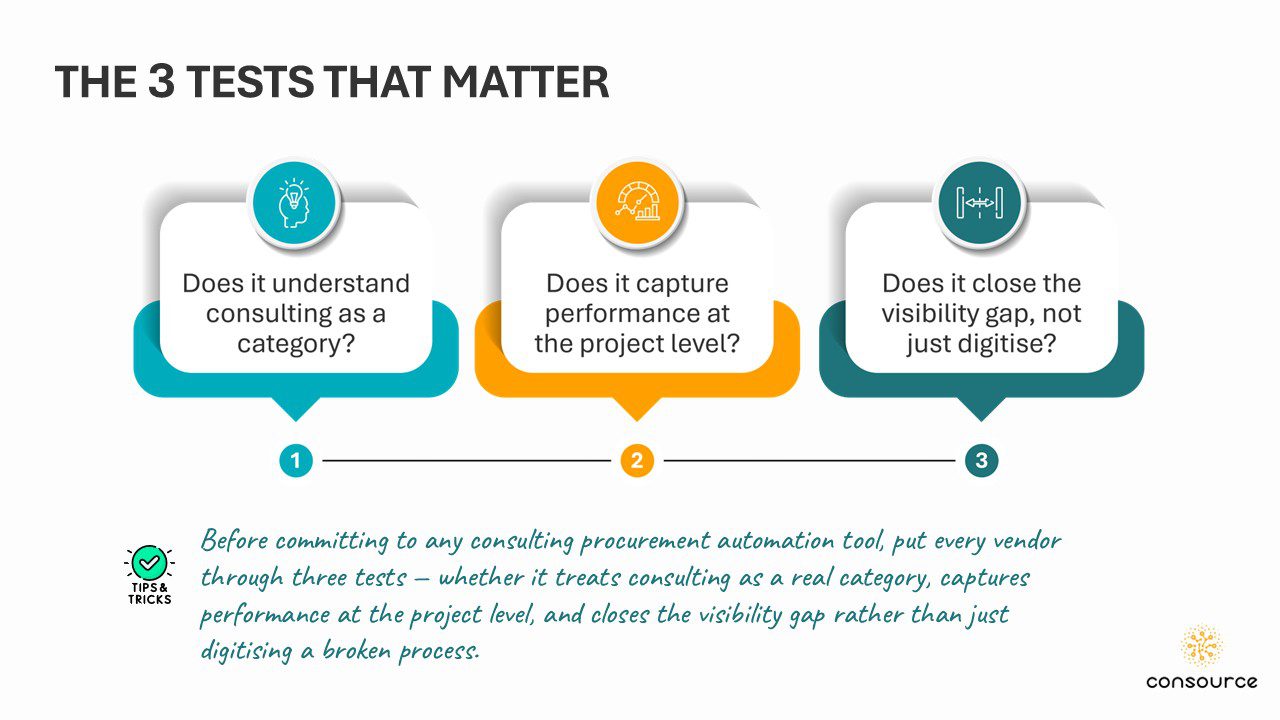
This is where the executive reader needs a diagnostic, and it comes down to three tests any automation vendor should be able to pass before a contract is signed.
Start with whether the tool understands consulting as a category or treats it as generic services spend. The answer reveals itself quickly: a tool built for consulting will have opinions about engagement structures, deliverable types, staffing pyramids, and the difference between fixed-price and time-and-materials work in this specific context, while a tool that treats consulting as a sub-folder of professional services will offer configurable fields and a sympathetic tone instead. The honest test is whether the vendor can show a live example of a spend view broken down by actual consulting work type, strategic, regulatory, technology, rather than describing the taxonomy as something the client can configure later.
That distinction only matters, though, if the data underneath it is granular enough to be useful, which is why the second test is whether performance is captured at the project level or only at the supplier level. Supplier-level data is a familiar artefact of procurement systems and largely useless in consulting, since the same firm produces excellent work on one engagement and indifferent work on the next, depending on which partner is leading, which juniors are staffed, and how well the scope was defined. The honest test here is whether the vendor can show two performance records for the same firm that disagree with each other, because if every engagement from a given firm scores the same, the system is averaging away the information that actually matters.
Getting both of those right still leaves the question that decides everything else: whether the tool closes the visibility gap or simply digitises the existing process. This is the easiest question to mishandle, since a great many automation projects produce a faster version of the broken process the organisation was already running, and finance discovers, somewhere around month nine, that the spend pattern has not changed and the decisions are still being made on the same incomplete information they always were. The honest test is whether the vendor can show what changed in a client’s actual sourcing decisions after adoption, beyond the usual gains in cycle time.
None of this is a scorecard exercise. A tool can pass the first test and fail the third, which is usually the more expensive failure to discover late.
AI-powered platforms have changed what good answers to these tests look like.
The Consulting Procurement Visibility Audit
Twelve questions across the four gaps this article names, information asymmetry, spend fragmentation, performance memory loss, and relationship-driven default, scored to show where your organisation sits: Foundational, Developing, Mature, or Leading.Take the audit
How Consource closes the visibility gap
Consource was built around the premise that consulting procurement is differently structured from the categories most procurement platforms were originally designed to manage. The category does not need a more elaborate workflow; it needs a different relationship between data and decision. That is what the platform attempts to provide.
The aggregate spend view, the living panel, the project-level governance integration, the structured performance capture, the compounding cross-engagement learning constitute the platform itself: procurement teams, finance leaders, and business stakeholders gain a shared view of the consulting portfolio as it is being shaped, rather than as it is being reported on six months later. The decisions that previously had to be made on incomplete information can be made on something closer to a complete picture, and the discipline of the category begins to compound rather than reset with every new engagement.
The claim here is narrower than eliminating the visibility gap entirely: the platform closes it deliberately, by treating consulting as the specific category it is rather than as a configurable instance of something more generic. For most organisations, that is a more useful starting point than another automation project that compresses approval cycles while leaving the underlying spend pattern undisturbed.
Process automation and category automation both have a place, and most procurement functions will eventually need both. What changes the outcome for consulting specifically is whether the tool actually closes the visibility gap or simply digitises the process around it. If you would like to see what that looks like in practice, book a free walkthrough of Consource.io and we can show you how the visibility gap closes when the tool is built for the category rather than adapted to it.
