
- Can you tell—right now—how much your company spent on consulting last quarter? By category? By supplier?
- Are your teams following a consistent process—or is it every business unit for themselves?
- Are you choosing the best supplier… or the on you know best?
Here’s the kicker: it’s not your fault. The tools weren’t built for this. The category wasn’t treated as strategic. And the result? Millions wasted, suppliers misaligned, and transformation initiatives stalling before they start. Enter digital procurement. Not as a shiny new toy, but as a mission-critical enabler for real change. In this article, we’ll dig into why traditional consulting procurement is so fundamentally flawed, what digital procurement actually changes (hint: everything), and how platforms like Consource.io are helping procurement and transformation leaders finally take control of this elusive category.
1. Consulting Procurement: A Different Beast
If consulting procurement had a dating profile, it would say: “It’s complicated.” Unlike traditional categories such as office supplies or raw materials, consulting is abstract, unpredictable, and deeply tied to strategic outcomes. You’re not buying a widget; you’re buying thinking, transformation, and expertise. And that creates a host of challenges procurement leaders can’t ignore.
📌 It’s Not About Price—It’s About Value
Let’s start with the elephant in the room: cost. In most procurement categories, price is king. Lower cost typically means better savings, and that’s a win. But with consulting? Not so fast. Consulting delivers intangible results—strategic clarity, operational improvement, digital acceleration—and those results don’t always show up in neat quarterly metrics. A cheaper proposal might actually cost more in the long run if it leads to mediocre recommendations, poor implementation, or change fatigue among teams. So, how do you evaluate value in a category where impact is subjective, timelines are fuzzy, and no two projects are the same? You need:
- A clear view of past performance (Did the last pricing optimization actually move the needle?)
- Contextual supplier benchmarks (How does Supplier A compare to B on this specific need?)
- Strategic alignment (Are we investing in the right initiatives at the right time?)
Spoiler: traditional systems can’t answer those questions. Not even close.
🧩 Complexity Comes Standard
Consulting procurement is complex not just because of what’s being bought but because of who’s buying it. Every function, from IT and Finance to HR and Marketing, has consulting needs. That leads to:
- Decentralized demand: Business units source consultants on their own, with limited coordination.
- Inconsistent processes: Some use RFPs. Others rely on word-of-mouth. Many skip sourcing altogether.
- Fuzzy budgeting: Spend gets buried in project budgets or OpEx lines, making tracking a nightmare.
Even well-intentioned procurement teams are flying blind. They don’t know what’s being sourced, by whom, or why. And that makes strategic sourcing almost impossible.
🚨 The Real Risks (a.k.a. Budget Sinkholes)
Without centralized visibility or control, companies face real, recurring risks:

- Maverick spend: Projects get launched outside of policy, with no competitive sourcing or contract governance.
- Duplicate efforts: Multiple teams solve the same problem differently—often hiring different firms for the same advice.
- Overreliance on the usual suspects: Without supplier intelligence, teams default to “who we know,” not “who’s best.”
Worst of all, you can’t improve what you can’t see. When consulting spend is scattered across systems and spreadsheets, tracking performance, ensuring alignment, and optimizing investment becomes wishful thinking.
2. Traditional Procurement: Death by the Office Suite
Let’s talk about the procurement tech stack that never meant to be one: Word, Excel, email, and a few “shared” folders that no one shares. Welcome to traditional consulting procurement, where every process is cobbled together from legacy habits, orphaned templates, and ERP data that’s about as readable as ancient Sanskrit. If this sounds familiar, you’re not alone. Most organizations managing consulting spend are stuck with a Frankenstein system, where bits of old processes are duct-taped to new-ish tools that don’t talk to each other. The result? Confusion, inconsistency, and chaos.
🗂️ Templates, Templates Everywhere—And Not a Single Source of Truth
Here’s how a typical RFP goes down: A stakeholder dusts off the last RFP they did (or borrows one from a colleague), tweaks the scope in a Word doc, pastes a table from Excel for the pricing sheet, then emails it to a shortlist of suppliers built entirely on institutional memory. Multiply that by every business unit, and you’ve got an RFP jungle where:
- No two templates are the same.
- No one knows which version is “approved.”
- Procurement is looped in too late—or not at all.
Even worse? Legal. Not because they’re too late to the party—but because there’s no party planning. Here’s how it typically goes: legal gets looped in before the project starts, as they should. But since there’s no pre-approved, consulting-specific contract or SOW template, they’re handed a Frankenstein doc—something cobbled together by the business or copied from a completely different project. Cue the rewrite. Now every clause is up for negotiation. Every line gets redlined. And since each legal counsel often uses their own version of “the right” format, you spend days—sometimes weeks—just getting to a usable draft. Meanwhile, the project clock is ticking. The supplier’s ready. The business is impatient. And procurement? Stuck in contract limbo for a deal that could have closed last month if there had just been a damn template.
📉 ERP and P2P: Great for Pencils, Useless for Projects
In theory, your ERP or P2P tool should help track spend and enforce compliance. In reality? For consulting, it’s a black hole. Here’s why:
- Descriptions are vague (“Consulting services,” “Transformation Project”)—no one knows what the PO actually covers.
- Categories are broad or misclassified—was that HR strategy or IT implementation?
- Supplier data is fragmented—duplicate vendors, inconsistent naming, zero performance tracking.
So even if you do manage to get data out of the ERP, it’s not actionable. It’s not strategic. And it definitely doesn’t help you decide whether to rehire a supplier, optimize your sourcing strategy, or negotiate better terms.
🔒 The Real Issue: Silos and Shadow Systems
At the heart of all this mess is a deeper problem—no central ownership. Procurement has partial visibility. Legal works in isolation. Business units run rogue. And no one is maintaining the actual tools (templates, workflows, dashboards) needed to run consulting procurement like a strategic category. This isn’t just inefficient. It’s risky.
- Projects go live with no formal contract.
- Sensitive scopes get buried in email threads.
- Supplier performance is never measured—because no one agreed on what success looked like.
It’s not the Office suite itself that’s the issue. It’s that every player builds their own little island with their own docs, formats, and processes. And when islands don’t connect, the whole procurement ecosystem sinks. Dig deeper into the digital transformation reshaping consulting procurement.
3. What Digital Procurement Actually Delivers
Let’s clear something up: digital procurement isn’t just putting your Word docs in the cloud and calling it a day. It’s not “emailing smarter.” And it’s definitely not slapping a workflow on top of chaos. True digital procurement, especially in the consulting space is about building an operating system for how expertise is sourced, evaluated, contracted, and measured. It replaces chaos with clarity, guesswork with governance, and scattered templates with strategic tools. Here’s what that looks like in practice.
📊 One Source of Truth (Finally)
Remember the chaos of siloed templates, scattered emails, and mystery project scopes? A modern digital platform brings everything together—intake forms, supplier databases, pricing benchmarks, performance scores—all in one place. With a platform like Consource.io, every stakeholder sees the same project data, the same list of approved suppliers, and the same sourcing process. No more chasing down version 9 of the “final_final” RFP or digging through inboxes for a scope doc someone swears they attached three weeks ago. You get:
- Centralized project intake and demand planning
- Automated RFP workflows with reusable templates
- Real-time dashboards for sourcing stage, supplier feedback, and progress tracking
The result? Alignment across procurement, business, and legal from Day 1.
🔁 Standardization Without Losing Flexibility
Let’s face it—consulting projects are inherently variable. But that doesn’t mean your process has to be. Digital platforms let you define how projects should be sourced and managed, while still allowing room for scope, pricing model, and supplier flexibility. With standardized templates and guardrails:
- Procurement can ensure consistency.
- Legal gets pre-approved language that doesn’t require a weekly rewrite.
- Stakeholders move faster without sacrificing control.
Think “build-your-own consulting engagement” with training wheels.
🧠 Supplier Intelligence That Doesn’t Suck
One of the biggest consulting procurement sins? Choosing suppliers based on who pitched best in a PowerPoint. With digital procurement, you build real intelligence over time. Platforms like Consource.io track:
- Past performance across similar projects
- Comparative pricing and day rates by category
- Supplier diversity, ESG metrics, and risk scores
So when a stakeholder says, “Let’s go with Firm X again,” you can respond with data, not déjà vu. “Actually, Firm Y delivered better results last year. What about we add them to the list of suppliers to compare?” Now that’s a conversation.
🛡️ Compliance and Governance on Autopilot
Let’s talk policy. Everyone loves to say there’s a standard sourcing process. But without automation? It’s just a wishlist. Digital procurement hardwires governance into the process:
- NDAs signed automatically during sourcing
- Approval workflows triggered based on the criteria
- Contract negotiation kickstarted with pre-approved templates
It’s not Big Brother—it’s Big Enabler. You reduce manual errors, eliminate bottlenecks, and make it easier for teams to do the right thing.
🧩 The Net Result: Time Back + Risk Down + ROI Up
At the end of the day, here’s what digital procurement really delivers:
- Time back: for procurement teams, legal, and business stakeholders.
- Risk down: with better documentation, audit trails, and compliance tracking.
- ROI up: by aligning projects to business priorities, improving supplier fit, and avoiding duplicated spend.
And most importantly? You finally treat consulting like the strategic investment it is—not just another PDF waiting to get signed.
4. Consource.io: The Consulting Game-Changer
Most digital procurement tools try to be everything to everyone. Consource.io doesn’t. It was built from the ground up for one mission: to transform how organizations buy and manage consulting services. Not office supplies. Not forklifts. Just consulting—deep, strategic, high-stakes work. That’s why it works so well.
🔧 Built for Consulting (Not Retro-Fitted)
Consource.io understands the messy realities of consulting procurement. The platform isn’t forcing consulting into a mold made for manufacturing. Instead, it’s designed around the workflows, data, and decision-making that make this category unique. What does that mean in practice?
- Project-first intake: Capture the business need, transformation goal, and expected outcome before the sourcing even begins.
- Consulting-specific templates: From RFIs to SoWs, everything is built for strategic services—not widgets.
- Expertise-driven evaluation: Go beyond pricing tables with structured evaluation tools tailored to assess fit, capability, and value.
This isn’t procurement tech with a “consulting module.” It’s the real deal.
🧩 Integrates If You Want It, Stands Alone If You Don’t
- Clean intake into Consource, routed from stakeholders or planners
- Smart workflows to manage sourcing, evaluation, and contracting
- Clear handoff into your ERP or P2P tool once the contract is signed
No duplication. No friction. Just flow.
📈 Performance Management That Doesn’t Wait for Invoices
Here’s the kicker: Consource doesn’t stop once the contract is signed. That’s where it starts to shine.
- Track project delivery vs. objectives
- Capture supplier feedback in real time
- Benchmark spend by category, business unit, or geography
Instead of looking backward after the budget’s gone, you get a forward-looking view of supplier impact. Which means you can reallocate, renegotiate, or retire suppliers with confidence. No more guessing who delivered real value. No more zombie vendors sticking around just because “we’ve always used them.”
💡 A Platform—and a Partner
Yes, Consource.io is software. But it’s also expertise. The platform is backed by decades of consulting procurement know-how (yes, including the team at Consulting Quest). That means clients don’t just get a tool—they get strategic support, best practice templates, and expert advice baked into the platform design. You’re not left wondering what good looks like. It’s built in.
🚀 Real-World Results, Real Fast
Clients using Consource.io have reported:
- Up to 30% faster sourcing cycles for consulting projects
- Higher supplier fit and satisfaction scores
- Improved visibility across 90%+ of consulting spend
- A net-positive ROI thanks to the value-sharing pricing model
One procurement leader put it best:
“It finally feels like we’re managing consulting instead of chasing it.”
5. Your Role in This Transformation
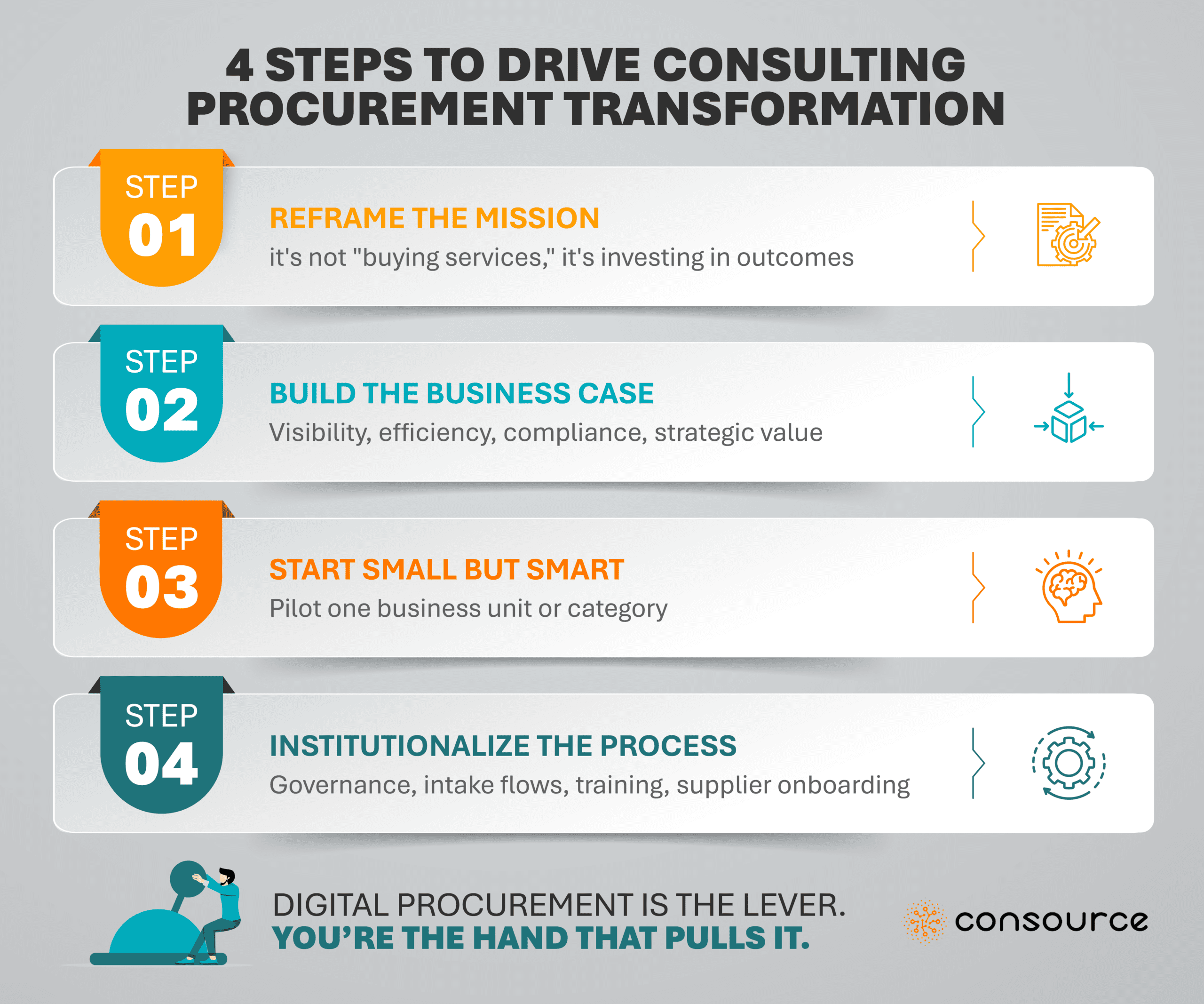
🧭 Step One: Reframe the Mission
Start by shifting how your organization thinks about consulting spend. This isn’t just about cutting costs. It’s about:
- Increasing ROI on strategic initiatives
- Aligning external expertise to internal priorities
- Reducing risk and improving speed to impact
In other words, it’s not “buying services.” It’s investing in outcomes. When that’s the mindset, everything changes—from how you prioritize sourcing to how you evaluate performance.
📣 Step Two: Build the Business Case (and Make It Stick)
To bring in a digital solution like Consource.io, you’ll need buy-in across legal, finance, business stakeholders, and IT. Here’s the good news: consulting is a category that touches everyone. That makes the case easier—if you anchor it in the right benefits. Key points to hit:
- Visibility: “Right now, we don’t know what we’re spending or whether it worked.”
- Efficiency: “We spend more time formatting Word docs than evaluating suppliers.”
- Compliance: “We don’t have an audit trail, and we’re exposed.”
- Strategic value: “This platform helps us tie every dollar to business impact.”
Throw in a few horror stories (e.g., the three-month contract saga for a project that started in week two), and you’ll have nods across the table.
⚙️ Step Three: Start Small—But Smart
Digital transformation doesn’t have to start with a big bang. Pick a pilot:
- A business unit with high consulting activity (e.g., Digital, Ops, HR)
- A category ripe for optimization (e.g., strategy, org design)
- A supplier panel that’s begging for structure
Run one wave through Consource.io. Show the improvements in cycle time, alignment, and satisfaction. Then scale. Pro tip: involve legal early. Show them the benefit of pre-approved templates, automated workflows, and version control. You might just turn your biggest bottleneck into your biggest ally.
🔁 Step Four: Institutionalize the Process
Transformation isn’t a project, it’s a shift in how your organization works. Once the pilot proves itself, it’s time to:
- Define clear governance (who owns what)
- Align stakeholders on intake and approval flows
- Train the business (and yes, get your favorite suppliers onboarded too)
This is where Consource.io shines by providing a single pane of glass where everyone works from the same playbook.
If You’re Still Running Consulting Procurement Like It’s 2005… You’re Losing
Let’s recap:
- Traditional consulting procurement is broken. Not because people aren’t trying—but because the tools, templates, and processes weren’t built for this category.
- Fragmented Word docs, homegrown RFPs, buried spend data, and legal chaos don’t just waste time—they destroy value.
- Digital procurement isn’t a buzzword anymore. It’s the minimum viable strategy for anyone serious about turning consulting from cost center to value engine.
And Consource.io? It’s not just a fix—it’s a force multiplier. It gives procurement leaders the tools to drive strategy, not just track invoices. It gives transformation officers visibility into what’s working and what’s not. And it gives organizations the structure they need to turn external expertise into internal success. Here’s the bottom line: the future of consulting procurement is digital. Not because it’s trendy—but because it’s better. More transparent. More efficient. More aligned with how businesses actually create value today.
Ready to stop chasing consulting chaos and start driving strategic value?
Book a free walkthrough of Consource.io and discover how we’re helping procurement and transformation leaders like you take control of their consulting investments—one smart decision at a time.
