
La plupart des directeurs financiers sont réellement satisfaits de la manière dont les dépenses de conseil sont gérées. Il y a une gouvernance en place, un processus à suivre, des approbations à donner et des budgets qui sont rarement dépassés de manière spectaculaire. De loin, la catégorie semble calme, contenue et - crucialement - le problème opérationnel de quelqu'un d'autre.
Ce confort dure généralement jusqu'à ce que les vrais chiffres fassent surface. Il ne s'agit pas de l'image conservée dans les rapports financiers, mais de la réalité consolidée de ce que l'organisation dépense réellement en conseil, une fois que la catégorie est débarrassée de ses déguisements. Le moment où les “services informatiques”, l“”accompagnement du changement“, les ”initiatives de transformation" et une poignée d'étiquettes comptables créatives se font discrètes. s'effondrer dans un ensemble inconfortable est souvent le moment où la confiance cède la place à la curiosité.
Une partie du problème est d'ordre sémantique. Le conseil est l'une des rares catégories de dépenses dont la définition n'est pas universellement partagée. Presque tout le monde est consultant de nos jours, qu'il s'agisse d'organisateurs de mariages, de spécialistes de la cybersécurité ou d'anciens partenaires stratégiques offrant des conseils exécutifs autour d'un café. Lorsque tout est considéré comme du conseil, tout ce qui ressemble à un contrôle précis devient facultatif et la visibilité devient largement théorique.
Ainsi, lorsque les responsables financiers affirment que les dépenses de conseil sont “sous contrôle”, ce qu'ils veulent généralement dire n'est pas que leur valeur est clairement comprise ou activement optimisée. Ce qu'ils veulent dire, c'est qu'il existe un cadre de gouvernance, que les factures sont validées et que rien ne s'est passé de manière catastrophique. Le processus fonctionne, au sens étroit du terme, c'est-à-dire qu'il ne connaît pas d'échec retentissant.
Le retour sur investissement, en revanche, est un sujet moins facile à aborder. Il s'agit de savoir si l'organisation obtient constamment les résultats escomptés. le meilleur possible Le résultat de ses dépenses de conseil semble étrangement conflictuel, comme si l'on remettait en question le jugement qui sous-tend des relations de longue date ou si l'on rouvrait des décisions qui ont déjà été approuvées et payées.
Pourtant, à mesure que la pression financière augmente et que la surveillance s'intensifie, on attend de plus en plus des directeurs financiers qu'ils aillent au-delà de l'assurance procédurale. Les dépenses de conseil ne sont plus seulement une question de contrôle, mais d'impact, de responsabilité et d'intention stratégique. Et ce changement commence par un examen direct d'une catégorie que de nombreux responsables financiers croient déjà comprendre - jusqu'à ce qu'ils le fassent en réalité.
Le paradoxe de la consultation du directeur financier
Lorsque les directeurs financiers pensent au conseil, ils imaginent généralement la partie visible de l'iceberg : les projets de conseil stratégique, souvent menés avec des entreprises de premier plan. Ces missions sont parrainées par l'exécutif, bien cadrées, politiquement visibles et relativement faciles à contrôler. Les honoraires sont élevés, mais les champs d'application sont clairs. Les décisions sont documentées. Les résultats sont débattus, même s'ils ne sont pas toujours mesurés.
D'un point de vue financier, cette tranche de dépenses de conseil semble familière et, surtout, gérable. Elle ressemble à un investissement. Elle se comporte comme tel. Elle fait l'objet d'une attention particulière parce qu'elle est proche du PDG et du conseil d'administration.
Le problème est qu'il ne représente qu'une fraction étonnamment faible des dépenses totales. Dans de nombreuses organisations, le conseil stratégique représente à peine 10 % du budget global de conseil. Parfois moins.
Les quatre-vingt-dix pour cent restants racontent une histoire bien différente.
Les dépenses réelles sont ailleurs - et surtout invisibles
La majeure partie des dépenses de conseil se fait dans la réalité opérationnelle, et non dans les salles de réunion. Conseil en informatique, intégration de systèmes, programmes d'excellence opérationnelle, refonte des processus, soutien réglementaire, PMO de transformation, projets de données, soutien à la cybersécurité - la liste est longue, peu glorieuse et financièrement importante.
C'est là que le conseil devient diffus. Les missions sont plus petites, plus fréquentes, moins standardisées et souvent renouvelées par habitude plutôt que par décision. Elles sont initiées par les équipes opérationnelles, approuvées rapidement et rarement remises en question sur le plan de la création de valeur. Individuellement, ils semblent inoffensifs. Collectivement, ils représentent une ponction structurelle à la fois sur le budget et sur l'attention.
Le problème n'est pas qu'elle n'est pas gérée ; c'est que la plupart d'entre elle n'apparaît même pas en tant que ‘conseil’ d'une manière que la finance peut piloter. Et ce qui n'est pas clairement visible est rarement remis en question.
L'exception du retour sur investissement que les directeurs financiers n'ont jamais eu l'intention de créer
C'est là que réside le véritable paradoxe. Les directeurs financiers sont réputés pour leur exigence en matière de retour sur investissement. Les dépenses d'investissement sont examinées à la loupe, les analyses de rentabilité sont disséquées, les synergies sont remises en question et les hypothèses sont soumises à des tests de résistance. Même des investissements internes relativement modestes peuvent susciter un débat intense.
Le conseil, cependant, est souvent échappe à ce niveau de discipline.
Ce n'est pas parce que les directeurs financiers estiment que le conseil n'est pas important, mais parce qu'il est considéré comme un soutien plutôt que comme un investissement. Une fois qu'un projet de conseil est approuvé, sa valeur est implicitement présumée. L'existence d'une gouvernance est prise pour une preuve d'impact. L'achèvement d'un projet devient un indicateur de réussite.
Cela crée une exception discrète à la rigueur financière. Une catégorie qui absorbe des millions, influence les décisions stratégiques et opérationnelles et façonne l'exécution est rarement soumise à une évaluation systématique du retour sur investissement. La question de savoir si une valeur a réellement été apportée semble gênante, voire inappropriée, en particulier lorsque les projets ont été parrainés par des dirigeants de haut niveau et réalisés par des entreprises réputées.
Pourtant, si la même logique était appliquée ailleurs - approuver des investissements sans suivre les résultats - elle serait considérée comme inacceptable.
La gouvernance sans curiosité n'est pas un contrôle
La plupart des organisations peuvent démontrer que les achats de services de conseil sont régis. Il existe des flux d'approbation, des fournisseurs privilégiés, des contrôles juridiques et des contrôles budgétaires. Du point de vue de la conformité, le système fonctionne.
Du point de vue de la valeur, il est largement passif.
La gouvernance répond bien plus souvent à la question “Était-ce autorisé ?” qu'à celle de savoir si cela en valait la peine. Au fil du temps, cette distinction est importante. Les dépenses de conseil ne sont ni chaotiques ni optimisées ; elles s'écoulent simplement.
Parce que les projets les plus visibles semblent contrôlés, les services financiers extrapolent l'ordre à l'ensemble de la catégorie, alors que la plupart des dépenses continuent à fonctionner en deçà d'une logique de retour sur investissement significative.
Les risques que personne ne gère (parce que personne ne regarde)
Le conseil est généralement considéré comme une question de coût. Occasionnellement comme une question de performance. Rarement comme une question de risque. Ce seul fait devrait mettre les responsables financiers mal à l'aise.
Dans la plupart des organisations, les sociétés de conseil opèrent avec un niveau d'accès et d'autonomie qui ferait froncer les sourcils dans presque n'importe quelle autre catégorie de fournisseurs. Ils ont accès à des données sensibles, influencent les décisions stratégiques, interagissent avec les dirigeants et façonnent parfois des récits qui survivent au projet lui-même. Pourtant, la manière dont les risques sont gérés dans le cadre des missions de conseil est souvent superficielle, incohérente ou tout simplement ignorée.
Non pas parce que les directeurs financiers sont négligents, mais parce que le conseil bénéficie depuis longtemps d'une image de fiabilité. Une marque réputée, un partenaire rassurant, des dossiers bien ficelés. Le risque semble abstrait, théorique et confortablement externalisé dans des clauses juridiques que personne ne relit après la signature.
Ce confort est mal placé.
La confidentialité est traitée comme une case à cocher et non comme une exposition
La plupart des projets de conseil impliquent l'accès à des informations confidentielles : données financières, feuilles de route stratégiques, hypothèses de fusion et d'acquisition, problèmes de performance interne, faiblesses organisationnelles. Des accords de confidentialité sont bien entendu signés. C'est là que s'arrête généralement la gestion des risques.
Ce qui est rarement examiné, c'est la cohérence avec laquelle la confidentialité est appliquée au cours des missions, en particulier lorsque plusieurs sociétés de conseil interviennent simultanément au sein de l'organisation. Les données sont partagées par le biais de courriels, de disques partagés, d'ateliers et de conversations informelles. Très peu d'organisations ont une vision structurée de qui a accès à quoi, pendant combien de temps et dans quelles conditions.
D'un point de vue financier et de conformité, il ne s'agit pas d'un oubli mineur. Il s'agit d'une exposition structurelle. Lorsque la confidentialité est gérée par projet plutôt que par fournisseur et par portefeuille, les fuites deviennent une question de probabilité et non d'intention.
Les conflits d'intérêts sont le problème de tous, donc personne n'en est responsable
Les cabinets de conseil travaillent avec plusieurs clients, souvent dans le même secteur, parfois sur des sujets remarquablement similaires. Il ne s'agit pas d'un secret, ni d'une pratique intrinsèquement contraire à l'éthique. Ce qui pose problème, c'est l'absence d'un mécanisme centralisé permettant d'identifier, de documenter et d'évaluer les conflits d'intérêts potentiels dans l'ensemble des activités de conseil d'une organisation.
La plupart des contrôles de conflits se font localement, au niveau du projet, sur la base de déclarations et de la bonne foi. Ils tiennent rarement compte de ce que la même entreprise fait ailleurs dans l'organisation, ou de la façon dont les rôles de conseil se chevauchent au fil du temps. Les responsables financiers supposent généralement que “quelqu'un” gère ce risque. Les responsables des achats supposent que le service juridique s'en occupe. Le service juridique suppose que les commanditaires savent ce qu'ils font. Les commanditaires supposent que l'entreprise parlerait en cas de problème.
Pour les directeurs financiers qui exigent des contrôles stricts sur les conflits financiers dans les audits, la trésorerie ou les fusions et acquisitions, la tolérance à l'égard des conflits de conseil est frappante. Le risque d'influence est considéré comme moins important, moins mesurable et donc moins urgent. Jusqu'à ce qu'il ne le soit plus.
La traçabilité des décisions est étonnamment fragile
Les projets de conseil échouent rarement de manière retentissante. Ce qu'ils font plutôt, c'est qu'ils se dissolvent discrètement dans la mémoire de l'organisation. Des recommandations sont émises, des diapositives sont archivées et des décisions sont prises - ou non - sans qu'il y ait une piste d'audit claire reliant les conseils aux résultats.
Du point de vue de la conformité, cette situation est problématique. Lorsque les régulateurs, les auditeurs ou les organes de gouvernance interne demandent pourquoi certaines décisions ont été prises, les organisations peuvent généralement indiquer les approbations et les budgets. Ce qu'elles peinent à démontrer, c'est la logique qui sous-tend les choix, les alternatives envisagées et les raisons de la sélection d'un partenaire ou d'une approche de conseil donné.
Dans un monde où la traçabilité des décisions est de plus en plus attendue, le conseil reste étrangement peu documenté. Non pas parce que l'information n'existe pas, mais parce qu'elle est dispersée dans des courriels, des présentations et des disques personnels. L'histoire peut être reconstituée, mais seulement au prix d'un effort - et souvent avec une mémoire sélective.
Les responsables financiers n'accepteraient jamais un tel niveau d'opacité pour les investissements en capital. Pourtant, en matière de conseil, c'est la routine.
Le risque est ignoré parce que rien n'a encore mal tourné
L'aspect le plus dangereux du risque de consultation est qu'il se manifeste rarement de manière immédiate. Les violations de la confidentialité sont subtiles. Les conflits d'intérêts sont difficiles à prouver. Les mauvais conseils ne déclenchent pas d'alarme ; ils conduisent simplement à des résultats décevants qui peuvent être imputés à l'exécution, à la culture ou aux conditions du marché.
Cela crée un faux sentiment de sécurité. Tant qu'il n'y a pas de scandale, pas d'action en justice et pas d'échec public, la catégorie semble sûre. Mais l'absence d'incidents est souvent la preuve d'une visibilité insuffisante, plus que d'un manque de contrôle.
Les responsables financiers sont formés à la réflexion probabiliste, mais le risque de consultation est traité de manière binaire : soit il y a un problème, soit il n'y en a pas. Cet état d'esprit serait inacceptable dans les domaines de la cybersécurité, de la conformité ou de l'information financière. Le conseil ne doit pas être l'exception.
L'inconfortable vérité est que le conseil en approvisionnement opère souvent dans une zone grise en matière de gouvernance. Le processus est lourd, l'intelligence du risque légère. Confiance par défaut, rarement vérifiée dans la pratique. Et tant que le conseil restera fragmenté, peu visible et peu documenté, cette zone grise persistera.
Et les dommages ne se limitent pas à la valeur. Le conseil obtient l'accès, l'influence et l'information avec beaucoup moins d'attention que n'importe quel autre type de fournisseur - et la finance ne s'en aperçoit généralement que lorsque cela devient un problème.
Les services financiers considèrent le conseil comme une dépense - et c'est là l'erreur principale
Une fois que l'on admet que le conseil est la seule catégorie où la discipline du retour sur investissement fait défaut, la question suivante devient brutale et pratique : que mesure-t-on et que cesse-t-on de financer ?
Les activités de conseil sont gérées comme des dépenses de fonctionnement. Des budgets sont alloués chaque année. Les dépenses sont contrôlées par rapport aux enveloppes. Les écarts sont expliqués. Les approbations sont accordées. Du point de vue du contrôle financier, la catégorie se comporte de manière acceptable. Prévisible, même.
Le problème est que le conseil n'est pas une dépense d'exploitation au sens économique du terme. Il s'agit d'un investissement dans le jugement, la capacité et l'accélération. Le traiter comme le loyer d'un bureau ou les frais de déplacement ne réduit pas le risque, mais neutralise l'ambition. L'organisation devient très douée pour autoriser le conseil et très mauvaise pour en extraire la valeur.
Les finances finissent par contrôler les dépenses plutôt que de façonner les résultats.
Pourquoi “rester dans les limites du budget” est une mesure de succès faible
La plupart des projets de conseil sont “dans le budget” avant même d'avoir commencé. L'exercice de sourcing produit des propositions, l'une d'entre elles est sélectionnée, un chiffre est convenu et ce chiffre devient le budget. La conformité est immédiate. Par définition.
Une fois le contrat signé, la discussion financière est effectivement terminée. Le projet n'est pas contrôlé par rapport à une hypothèse économique ; il est simplement exécuté par rapport à un chiffre dérivé de la propre proposition des consultants.
Ce que presque personne ne réexamine, c'est la question de savoir si ce budget était le bon au départ.
Le champ d'application était-il justifié ? Le problème était-il réel, urgent et méritait-il d'être externalisé ? maintenant? La consultation était-elle le meilleur levier, ou simplement le plus rapide ? Ces questions se posent en amont de la passation de marchés, mais elles sont rarement posées avec un sérieux financier. Une fois qu'un projet est soutenu par la direction et qu'il est plausible, le budget devient une formalité plutôt qu'une décision.
Comparez cela à n'importe quelle autre catégorie d'investissement. Les dépenses d'investissement sont débattues avant d'être approuvées, remises en question pendant leur exécution et examinées après coup. Le conseil échappe à cet examen minutieux non pas parce qu'il est plus performant, mais parce que sa valeur est plus difficile à confronter sans créer de frictions.
Le véritable échec n'est donc pas que les projets de conseil dépassent les budgets. C'est que personne ne se préoccupe de savoir si le budget a jamais mérité d'exister.
Et dans le domaine de la finance, cela devrait être une pensée profondément inconfortable.
Le retour sur investissement n'est pas la même chose que l'analyse de rentabilité
Soyons honnêtes : la plupart des projets de conseil ne s'accompagnent pas d'une analyse de rentabilité. Ils sont accompagnés d'une justification.
Quelques diapositives, une plate-forme en feu, une ligne du temps qui, comme par magie, ne peut pas bouger, et une phrase familière : “Nous avons besoin de soutien.” Quelqu'un de haut placé acquiesce, le service des achats lance un processus d'approvisionnement, le service financier valide les dépenses et l'organisation a réussi à convertir “nous pensons que c'est important” en “nous payons pour cela”.”
Lorsque le ticket est de quelques centaines de milliers, c'est déjà discutable. Lorsqu'il s'agit de quelques millions, cela devient une habitude que la finance ne tolérerait nulle part ailleurs.
La vérité est que de nombreux projets de conseil sont approuvés sans définition explicite des résultats. Non pas parce que les résultats sont impossibles à définir, mais parce que leur définition oblige à une conversation que les gens préfèrent éviter : Avons-nous vraiment besoin de cela ? Maintenant ? À ce prix ? Et qu'est-ce qui sera différent une fois que ce sera fait ?
Oui, une partie de la valeur du conseil est intangible. Changement de culture, alignement des dirigeants, engagement des employés, “élan”. D'accord. Mais “intangible” ne signifie pas “non mesurable”. Cela signifie que vous devez choisir des indicateurs, vous y engager et les suivre avec le même sérieux que vous appliquez à tout autre pari stratégique.
La catégorie n'est pas non plus une grande masse. La plupart des projets de conseil se répartissent en quelques familles prévisibles, et chaque famille a une logique de retour sur investissement différente :
- Stratégique des projets : Le retour sur investissement est une question de décisions, d'établissement de priorités, d'erreurs évitées, de délai de mise en œuvre.
- Réglementation / conformité Les projets : Le retour sur investissement concerne les risques évités, l'état de préparation, les résultats des audits et le coût de la non-conformité.
- Excellence les projets (dans toutes les fonctions) : Le retour sur investissement concerne les deltas de performance mesurables - temps de cycle, coût du service, productivité, taux d'erreur, fonds de roulement.
- Facilitateurs (informatique, données, PMO de transformation) : Le retour sur investissement concerne l'accélération de l'exécution, la fiabilité de la livraison, l'adoption et la réduction du travail à refaire.
Rien de tout cela n'exige de prétendre que le conseil est un actif parfaitement quantifiable. Il faut refuser l'alternative paresseuse qui consiste à approuver des millions sans définition commune de la réussite, puis à s'étonner que l“”impact" devienne une question d'opinion.
C'est là le véritable paradoxe : les directeurs financiers exigent une logique de résultat pour presque toutes les catégories d'investissement, à l'exception de celle qui se vend littéralement comme “impact”.”
L'angle mort du portefeuille
Le problème le plus profond est que le conseil n'est presque jamais gérés comme un portefeuille. Les projets sont évalués individuellement, approuvés individuellement et oubliés individuellement. Il n'existe pas de vue d'ensemble de la manière dont les investissements en matière de conseil se comparent, se concurrencent ou se complètent.
En conséquence, les responsables financiers ne peuvent pas répondre en toute confiance à des questions stratégiques simples :
- Quelles sont les initiatives de conseil qui ont généré le plus de valeur l'année dernière ?
- Quels sont les types de projets systématiquement sous-performants ?
- Quelles sont les entreprises qui génèrent un impact répété et quelles sont celles qui génèrent des factures répétées ?
- Où l'organisation dépense-t-elle trop par rapport aux résultats ?
En l'absence de logique de portefeuille, la hiérarchisation des priorités est dictée par le parrainage plutôt que par l'économie. L'urgence remplace la valeur. La visibilité remplace l'impact. C'est le projet le plus bruyant qui l'emporte, et non le plus prometteur.
La création de valeur exige que la finance change d'attitude
Passer du contrôle des coûts à la création de valeur ne signifie pas relâcher la gouvernance. Il s'agit de l'améliorer.
Pour les directeurs financiers, cela nécessite un changement subtil mais significatif. Le conseil doit cesser d'être considéré comme un inconvénient nécessaire et commencer à être traité comme une classe d'actifs stratégiques. Une catégorie qui mérite une visibilité, des repères, un suivi des performances et une pression sélective.
Cela ne signifie pas qu'il faille transformer chaque projet en un exercice de tableur. Cela signifie qu'il faut insister sur la clarté là où l'ambiguïté est devenue confortable. Quel problème ce projet était-il censé résoudre ? Qu'est-ce qui a changé à la suite de ce projet ? Le financerions-nous à nouveau en sachant ce que nous savons maintenant ?
Ces questions ne sont pas hostiles. Ce sont les questions que les responsables financiers posent partout ailleurs.
Tant que le conseil ne sera pas soumis à la même honnêteté intellectuelle que les autres investissements, les organisations continueront à confondre discipline de dépense et discipline de valeur. Elles auront l'impression de contrôler la situation tout en payant discrètement une prime à l'incertitude.
Pour un directeur financier, il s'agit là d'un angle mort remarquablement coûteux.
Les directeurs financiers manquent rarement de données. Ce qui leur manque, c'est la visibilité.
Sur le papier, les dépenses de conseil sont visibles. Dans la pratique, elles sont fragmentées, diluées et politiquement neutralisées. Les systèmes financiers enregistrent fidèlement les factures, mais ils n'expliquent pas l'intention. Ils enregistrent les coûts, mais pas le contexte. Ils vous disent que l'argent a été dépensé, et non pourquoi, pour quel résultat, ou alors si cela a fait la moindre différence.
Quand le conseil disparaît dans la comptabilité
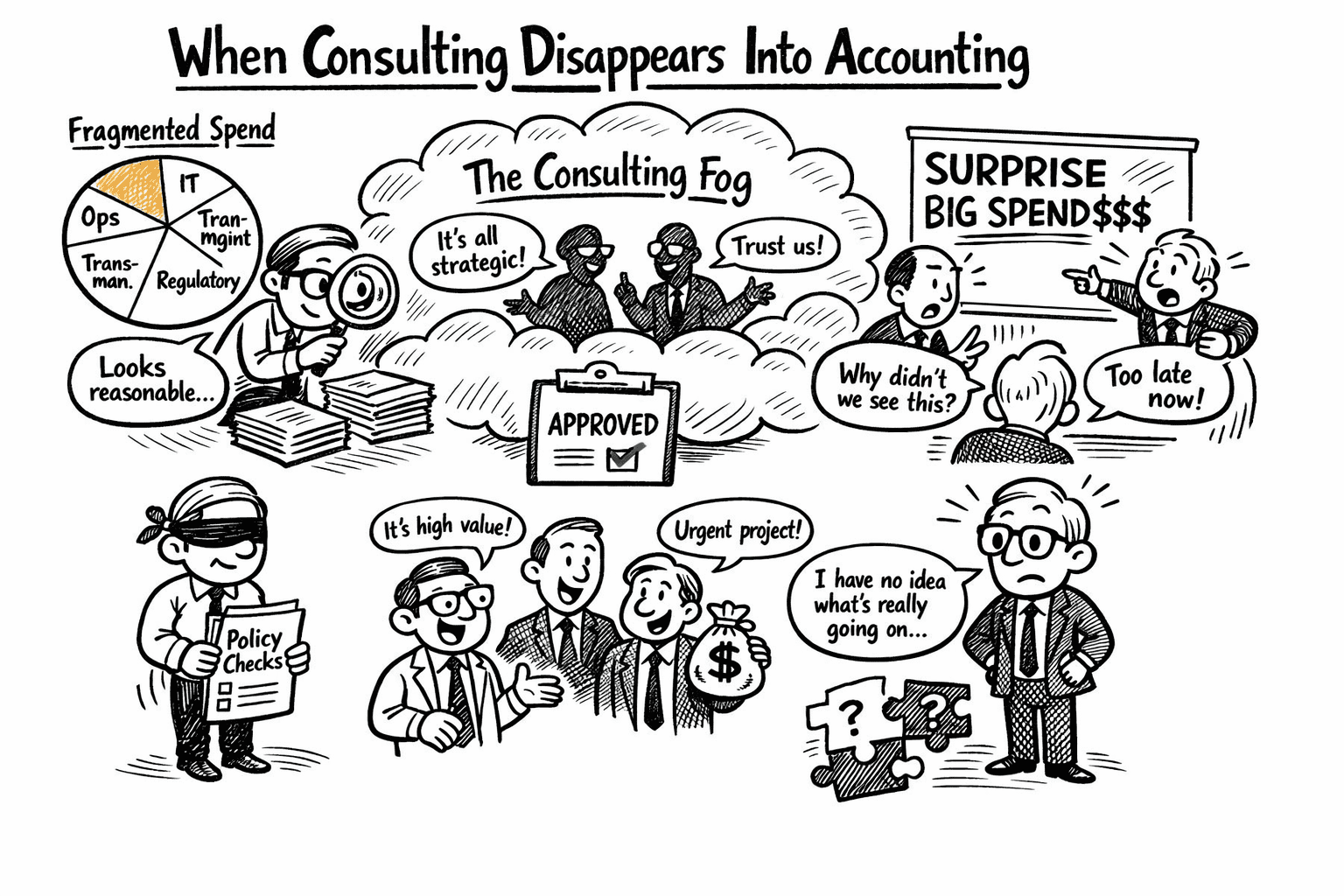
Dans la plupart des organisations, le conseil n'existe pas en tant que catégorie gérée activement par les services financiers. Il s'agit d'une étiquette qui disparaît dès qu'elle apparaît dans le grand livre.
Une fois codé, le conseil devient services informatiques, soutien opérationnel, gestion du changement, transformation numérique, assistance réglementaire, ou quelque hybride qui s'aligne commodément sur celui qui l'a demandé. Chaque étiquette est défendable. Collectivement, elles effacent la catégorie.
Le résultat est prévisible. Les responsables financiers voient des fragments, mais jamais l'ensemble. Les dépenses semblent raisonnables isolément, justifiées localement et donc à l'abri d'une remise en question globale. Aucun projet ne semble suffisamment excessif pour être remis en question. Aucun poste n'a assez de poids pour déclencher une escalade.
C'est ainsi que des budgets de plusieurs millions d'euros restent invisibles.
Une visibilité qui arrive trop tard pour compter
De temps en temps, quelqu'un demande une analyse des dépenses de conseil. Un groupe de travail est constitué. Les données sont extraites, rapprochées, nettoyées, débattues, corrigées et enfin présentées. Les chiffres sont presque toujours plus élevés que prévu. L'exercice est jugé utile. Des leçons sont tirées.
Puis la vie reprend son cours.
Le problème n'est pas que ces analyses soient erronées. C'est qu'elles sont épisodiques. La visibilité arrive après que les décisions ont été prises, les contrats signés et l'argent dépensé. Elle informe les rétrospectives, pas les choix.
Pour les responsables financiers habitués à des tableaux de bord en temps réel partout ailleurs, ce retard devrait être inacceptable. Pourtant, le conseil échappe d'une manière ou d'une autre à l'attente d'une visibilité continue. La catégorie est réexaminée lorsqu'elle devient inconfortable, et non parce qu'elle fait l'objet d'un suivi stratégique.
Vous ne pouvez pas gouverner ce que vous ne voyez pas clairement
Lorsque le service financier ne dispose pas d'une vue consolidée et en temps réel des dépenses de conseil dans l'ensemble de l'organisation, il ne peut pas influencer l'établissement des priorités. Elle ne peut pas remettre en cause les doublons. Elle ne peut pas arbitrer entre des initiatives concurrentes. Il ne peut pas comparer l'impact entre les projets ou les fournisseurs.
Plus important encore, elle ne peut pas dire non en toute confiance.
C'est la raison pour laquelle la gouvernance consultative se résume souvent à des contrôles de procédure. La finance vérifie que les règles ont été respectées car elle ne dispose pas des informations nécessaires pour juger si la décision elle-même était sensée. L'approbation remplace l'arbitrage. La conformité remplace la stratégie.
Le coût caché de la fragmentation
La fragmentation des dépenses de conseil a une autre conséquence dont on parle rarement : elle affaiblit la position de la finance dans les conversations stratégiques.
Lorsque les responsables financiers ne sont pas en mesure d'articuler l'ensemble de l'image du conseil, d'autres le font pour eux. Les chefs d'entreprise définissent la valeur. Les consultants définissent l'urgence. Le service financier réagit.
C'est l'aboutissement logique de la gestion du conseil par le biais de catégories comptables plutôt que par la logique économique. L'organisation se retrouve avec une précision financière détaillée et une cécité stratégique.
Les directeurs financiers n'ont pas besoin de plus de rapports. Ils ont besoin d'un moyen de reconnecter les dépenses de conseil aux décisions, aux résultats et aux compromis pendant que ces décisions sont encore ouvertes.
Jusqu'à ce que cela se produise, le conseil continuera d'opérer dans une zone grise confortable. Suffisamment visible pour être payé. Suffisamment invisible pour éviter un examen approfondi.
Pourquoi ce problème ne se règle jamais de lui-même (et pourquoi les directeurs financiers doivent s'en préoccuper)
Si les marchés publics de services de conseil étaient naturellement autocorrectifs, ils se seraient déjà corrigés.
Ce n'est pas le cas. Et ce n'est pas parce que les organisations manquent d'intelligence, d'intention ou de bonnes personnes. C'est parce que le modèle opérationnel actuel empêche activement l'apprentissage. Les décisions sont prises localement, les dépenses sont fragmentées structurellement, les résultats sont faiblement suivis et les risques sont gérés sur le papier plutôt que dans la pratique. Rien dans ce système n'incite à l'amélioration.
Laissées à elles-mêmes, les dépenses de conseil font exactement ce que fait toute catégorie mal gouvernée : elles se développent, s'étendent et se normalisent.
Le mythe de la “propriété d'entreprise”
Une réponse fréquente de la part des services financiers est de renvoyer la responsabilité du conseil aux entreprises. Après tout, les chefs d'entreprise savent ce dont ils ont besoin, parrainent les projets et travaillent avec les consultants au quotidien. En théorie, cela semble raisonnable. En pratique, il s'agit d'une abdication commode.
Les chefs d'entreprise sont incités à livrer localement, et non à optimiser globalement. Ils se soucient de la rapidité, du soutien et de l'exécution au sein de leur périmètre. Ils sont rarement récompensés lorsqu'ils remettent en question les champs d'application, comparent les prix ou se demandent si un soutien externe est toujours justifié six mois plus tard. Attendre d'eux qu'ils se comportent comme des investisseurs de portefeuille est au mieux optimiste.
Les services financiers ne délégueraient jamais entièrement la discipline d'allocation des capitaux aux promoteurs de projets. Le secteur du conseil ne devrait pas être différent.
Les marchés publics ne peuvent à eux seuls supporter le poids de la crise
Les équipes chargées des achats tentent souvent d'imposer une structure aux dépenses de conseil. Listes de fournisseurs privilégiés, grilles tarifaires, processus d'approvisionnement, appels d'offres concurrentiels. Ces outils sont importants, mais ils ne suffisent pas à eux seuls.
Acheter du conseil, ce n'est pas seulement acheter des heures moins chères. Il s'agit d'acheter de meilleurs résultats. L'approvisionnement peut optimiser les prix et les processus, mais il n'est pas possible d'obtenir de meilleurs résultats. ne peut pas définir la valeur de manière isolée. Si les services financiers ne définissent pas activement les règles du jeu, les achats se retrouvent à imposer le respect des règles plutôt qu'à favoriser les performances.
C'est ainsi que la passation de marchés de conseil devient une procédure plutôt qu'une stratégie.
Pourquoi les directeurs financiers sont les seuls à pouvoir briser le modèle
L'inconfortable réalité est qu'aucune fonction autre que la finance n'a à la fois la légitimité et la perspective de changer la façon dont le conseil est géré.
Les directeurs financiers se trouvent à l'intersection des dépenses, des risques, de la gouvernance et de la performance. Ils se soucient de la visibilité parce qu'elle permet de faire des choix. Ils s'intéressent au retour sur investissement parce qu'il signale la discipline. Ils se soucient de la conformité parce qu'elle protège l'organisation. Plus important encore, ils ont le pouvoir de redéfinir ce qu'est le “bien”.
Lorsque les directeurs financiers restent passifs, le conseil reste une dépense tolérée. Lorsque les directeurs financiers s'engagent, le conseil devient une catégorie d'investissement avec des attentes.
Il ne s'agit pas de microgérer des projets ou de critiquer les dirigeants. Il s'agit de fixer des normes. Ce qui doit être visible. Ce qui doit être justifié. Ce qui doit être mesuré. Et ce qui ne sera plus accepté simplement parce que “c'est ainsi que nous avons toujours fait”.”
Le coût de l'inaction est prévisible
Les organisations qui ne gèrent pas activement le conseil en tant que catégorie ne s'effondrent pas. Elles dérivent.
Les dépenses augmentent sans corrélation claire avec l'impact. Les mêmes entreprises réapparaissent d'un projet à l'autre, avec peu d'enseignements cumulés. Les risques s'accumulent en silence. Et la finance continue d'expliquer des résultats qu'elle n'a pas influencés.
Les directeurs financiers qui reconnaissent ce modèle ont le choix. Ils peuvent continuer à s'appuyer sur une gouvernance conçue pour le contrôle et accepter n'importe quelle valeur qui émerge. Ou ils peuvent réaffirmer leur leadership financier sur une catégorie qui a été autorisée à fonctionner sur la base de la confiance, de l'habitude et de la fragmentation pendant bien trop longtemps.
La section suivante concrétise ce choix en examinant ce qui change réellement lorsque les marchés publics de services de conseil sont traités comme un système stratégique plutôt que comme un processus administratif.
Ce qui change réellement lorsque le conseil est géré comme un investissement
C'est généralement à ce moment-là que les articles dérivent vers des abstractions. “Meilleur alignement”. “Amélioration de la collaboration”. “Amélioration de la prise de décision”. Des phrases réconfortantes, sans grandes conséquences.
Soyons plus précis. Lorsque l'acquisition de services de conseil est traitée comme un système stratégique plutôt que comme un processus administratif, trois choses changent immédiatement - et de manière inconfortable - pour le mieux.
Première : Le conseil devient visible en tant que catégorie, et non comme un effet secondaire
Le changement le plus perturbateur est aussi le plus simple : le conseil cesse de se cacher.
Au lieu d'être dispersé dans les centres de coûts et mal étiqueté dans les structures comptables, le conseil réapparaît comme ce qu'il est réellement - une catégorie d'investissement transversale couvrant la stratégie, l'informatique, les opérations, la transformation et le risque. Pas de manière rétroactive. Pas une fois par an. En permanence.
Il s'agit de créer une source unique de vérité qui relie les projets, les fournisseurs, les dépenses et les résultats. Lorsque les services financiers peuvent voir toute l'activité de conseil en un seul endroit, les conversations changent. Les questions deviennent plus pointues. Les compromis deviennent explicites.
Soudain, l'organisation ne peut plus prétendre que le conseil est “sous contrôle” sans définir ce que le contrôle signifie réellement.
Deuxièmement : la gouvernance cesse d'être défensive et commence à être économique
La gouvernance traditionnelle en matière de conseil est conçue pour protéger l'organisation contre les défaillances de procédure. Le fournisseur a-t-il été approuvé ? Le budget a-t-il été validé ? Les étapes légales ont-elles été respectées ?
La gouvernance orientée vers l'investissement pose des questions différentes. Pourquoi ce projet plutôt qu'un autre ? Pourquoi cette entreprise pour ce problème ? Pourquoi maintenant ? À quoi ressemblerait le succès - et comment saurons-nous si nous l'avons manqué ?
Cela ne ralentit pas les choses. Au contraire, cela élimine l'ambiguïté. Lorsque les attentes sont explicites, moins de projets reposent uniquement sur l'intuition et le parrainage. Lorsqu'il existe des points de référence, les débats sur les prix deviennent factuels plutôt qu'émotionnels. Lorsque les performances passées sont visibles, la sélection des fournisseurs cesse d'être anecdotique.
La gouvernance cesse d'être un frein. Elle devient un filtre.
Troisièmement : le retour sur investissement cesse d'être théorique
C'est là que la plupart des organisations abandonnent discrètement. Mesurer le retour sur investissement du conseil semble difficile, subjectif et politiquement risqué. Elles ne le font donc pas.
Gérer le conseil comme un investissement n'exige pas une fausse précision. Elle exige de la cohérence. Définir d'emblée les résultats attendus. Suivre les résultats par rapport à ces attentes. Comparer des projets similaires en termes de durée, de portée et de fournisseurs. Apprendre quels types d'engagements tendent à créer de la valeur - et lesquels déçoivent systématiquement.
Au fil du temps, des schémas se dessinent. Il ne s'agit pas de réponses parfaites, mais d'une intelligence directionnelle. Suffisamment pour éclairer les décisions futures. Suffisamment pour cesser de répéter les mêmes erreurs en toute confiance.
C'est ainsi que les dépenses de conseil deviennent des connaissances cumulatives plutôt qu'une amnésie récurrente.
Pourquoi Consource s'inscrit-il dans ce contexte ?
Consource n'existe pas pour “optimiser” comme par magie les dépenses de conseil ou les rendre moins chères par défaut. Il existe pour rendre le conseil visible, gouvernable et comparable de manière à ce que la finance puisse réellement l'utiliser.
En centralisant les projets de conseil, les fournisseurs et les dépenses sur une plateforme unique, Consource offre aux directeurs financiers ce que les systèmes financiers traditionnels n'offrent jamais : une vue consolidée et opérationnelle de la catégorie de conseil pendant que les décisions sont encore prises, et non pas des mois plus tard.
Consource structure l'ensemble du cycle de vie du conseil, du sourcing et des appels d'offres à l'exécution et au suivi du projet, avec une gouvernance intégrée directement dans les flux de travail. Les accords de confidentialité, les approbations et les étapes de décision ne sont pas des contrôles distincts ajoutés par la suite ; ils font partie de la manière dont les services de conseil sont acquis et gérés depuis le début.
Avec le temps, cela crée quelque chose qui manque totalement à la plupart des organisations : la continuité. Les projets ne sont plus des événements isolés. Les fournisseurs ne sont plus évalués dans le vide. Les services financiers peuvent voir comment des engagements similaires ont été obtenus, ce qu'ils ont coûté, comment ils ont été gérés et comment ils se sont déroulés dans l'ensemble de l'organisation.
Il ne s'agit pas de prédire le retour sur investissement avec une précision artificielle. Il s'agit de créer des comparabilité-Les décisions futures sont ainsi fondées sur l'expérience plutôt que sur la mémoire ou l'habitude.
Consource est conçu pour fonctionner de manière autonome ou intégré aux systèmes existants via des API, ce qui permet aux services financiers et d'approvisionnement de retrouver une visibilité sans perturber les processus existants. Et parce que le conseil implique par nature des informations sensibles, la plateforme est construite avec une sécurité et une conformité de niveau entreprise à l'esprit, y compris la certification SOC 2 Type II.
Plus important encore, Consource permet à la finance de retrouver son rôle naturel. Non pas en tant que gardien validant les factures, mais en tant que gestionnaire d'une catégorie qui influence la stratégie, l'exécution et le risque bien au-delà de son empreinte comptable.
Ce n'est pas une transformation. C'est du rattrapage.
Rien de tout cela n'est radical. Les directeurs financiers appliquent déjà cette logique à l'allocation des capitaux, aux fusions et acquisitions et aux investissements informatiques majeurs. Le conseil a simplement été laissé à la traîne, protégé par la complexité et la politesse.
Ce que font les plateformes comme Consource, c'est de supprimer les excuses. Une fois que la visibilité existe, l'indifférence devient un choix. Une fois que des repères sont disponibles, surpayer devient une décision délibérée. Une fois les résultats suivis, la répétition de projets à faible impact devient indéfendable.
À ce moment-là, le conseil en approvisionnement cesse d'être un angle mort. Il devient un levier.
Et les directeurs financiers retrouvent quelque chose qu'ils avaient discrètement perdu en cours de route : la capacité de dire, avec des preuves plutôt que des espoirs, que ces dépenses ne sont pas seulement contrôlées, mais qu'elles en valent la peine.
Conclusion - L'angle mort le plus coûteux est celui que l'on accepte
Pendant des années, le conseil a bénéficié d'une forme particulière d'immunité. Il est suffisamment cher pour être important, suffisamment complexe pour intimider et suffisamment stratégique pour décourager les questions gênantes. Tant que la gouvernance existe et que rien ne se passe visiblement mal, la catégorie est autorisée à fonctionner sur la base de la confiance, de l'habitude et des bonnes intentions.
Cette tolérance n'est plus neutre. Dans un contexte de budgets plus serrés, de surveillance accrue et d'attentes plus élevées en matière de risques, le fait de ne pas savoir où va l'argent des consultants n'est plus un angle mort inoffensif - c'est une défaillance du leadership.
L'ironie est que les directeurs financiers savent déjà comment gérer ce type de problème. Ils le font tous les jours avec des investissements en capital, des acquisitions et des programmes de transformation majeurs. Le conseil a simplement été laissé de côté, considéré comme un soutien plutôt que comme l'investissement qu'il a toujours été. Le résultat est une catégorie qui se sent contrôlée tout en échappant tranquillement à la discipline appliquée partout ailleurs.
Pour combler cet angle mort, il n'est pas nécessaire de transformer la finance en une force de police consultative. Il faut rétablir la logique financière là où elle a été poliment suspendue. Une visibilité qui reflète la réalité, et non des étiquettes comptables. Une gouvernance qui évalue les choix, et pas seulement la conformité. Un suivi des performances qui crée un apprentissage plutôt qu'une justification. Et une gestion des risques qui reconnaisse que l'influence est aussi sensible que le capital.
C'est là que Consource change l'équation. En donnant aux responsables financiers une vision claire, consolidée et continue de l'activité de conseil, Consource permet aux directeurs financiers de passer d'une approbation passive à une gestion active. Le conseil cesse d'être un coût toléré pour devenir un portefeuille géré. Les décisions retrouvent une traçabilité. La valeur devient discutable. L'indifférence devient impossible.
L'inconfortable vérité est que l'angle mort n'a jamais été technique. Il était culturel. Et les cultures changent lorsque les dirigeants décident que le “suffisamment bon” n'est plus acceptable.
Si le conseil est important pour votre organisation - et il l'est -, il mérite la même rigueur que tout autre investissement stratégique.
Réserver une visite guidée gratuite de Consource.io et découvrez comment vos achats de services de conseil peuvent enfin fonctionner comme il se doit.



0 commentaires