
Si vous avez déjà lu un contrat de consultation et pensé :, “ Cela pourrait aussi être considéré comme de la poésie abstraite. ” — vous n'êtes pas seul. Entre des cahiers des charges qui ressemblent à des devinettes tirées d'un biscuit chinois et des processus d'approbation régis par des e-mails polis, les services de conseil en matière d'approvisionnement posent un problème de risque. Et un problème de conformité. Et, franchement, un problème de crédibilité.
Ce n'est pas que les entreprises ne vouloir pour gérer les risques. C'est juste que les outils d'approvisionnement traditionnels traitent le conseil comme s'il s'agissait d'acheter des chaises de bureau, alors qu'en réalité, cela s'apparente davantage à l'embauche d'un chirurgien cérébral sur la base d'une poignée de main.
Le conseil n'est pas une dépense ordinaire. Il s'agit d'une activité stratégique, nuancée et souvent politiquement sensible. Cela signifie que les risques ne sont pas seulement juridiques, mais aussi opérationnels, financiers et liés à la réputation. Et la plupart des équipes d'approvisionnement avancent à l'aveuglette.
Mais voici le hic : ce n'est pas inévitable. Avec les bons outils — les bons plateforme — vous pouvez transformer le chaos du conseil en une gouvernance structurée et stratégique. C'est là que Consource entre en jeu.
Dans cet article, nous vous dévoilerons les raisons pour lesquelles les processus d'approvisionnement en services de conseil déraillent, pourquoi votre cadre de conformité pourrait discrètement échouer et comment Consource vous offre une nouvelle stratégie, qui permet de gérer les risques sans nuire à la rapidité, à l'innovation ou à la santé mentale.
1. La roulette du risque : quand les achats de services-conseils tournent mal
Bienvenue dans la partie de l'article où nous cessons de prétendre que les services de conseil en matière d'approvisionnement constituent une catégorie bien définie et où nous reconnaissons la vérité : il s'agit d'un magnifique chaos complexe. Un jeu à haut risque où interviennent des partenaires charismatiques, des parties prenantes changeantes, des champs d'application ambigus et juste assez de gouvernance pour que tout le monde sentir sûr, mais pas suffisamment pour protéger réellement l'entreprise.
Si les achats avaient un casino, le conseil serait la table de blackjack où la moitié des joueurs jurent qu'ils comptent les cartes et l'autre moitié pense que la “ gestion des risques ” consiste à demander gentiment au consultant de ne pas trop dépenser.
Analysons les risques qui comptent vraiment : ceux dont vos auditeurs parlent à voix basse, ceux qui empêchent votre équipe juridique de dormir et ceux dont votre directeur financier suppose qu'ils “ sont pris en charge quelque part ”.”
1.1. Les suspects habituels : là où les risques importants se cachent à la vue de tous
Bien sûr, tout le monde s'inquiète des tarifs et des modifications de commande, mais quels sont les risques réels ? Ils sont plus subtils, et souvent totalement invisibles jusqu'à ce que quelqu'un ressorte le projet six mois plus tard et dise : “ Attendez... nous avons approuvé... ceci?”
👉 Le piège de l'ambiguïté : des champs d'application vagues, des résultats vagues, une exposition très réelle
Les domaines de consultation sont réputés pour être suffisamment précis pour paraître intelligents, mais suffisamment vagues pour être interprétés de six façons différentes.
Si vous avez déjà vu une lunette qui indique :
“ Soutenir le programme de transformation en fournissant des informations stratégiques et des conseils. ”
vous connaissez déjà le problème.
Des champs d'application vagues conduisent à :
- Attentes mal alignées
- Le « gold-plating » (au sens où l'entendent les consultants, et non les acheteurs)
- Dérive budgétaire
- Aucune responsabilité
Et quand personne ne peut dire exactement ce qui a été acheté, bonne chance pour faire respecter la conformité.
👉 Conflits d'intérêts : un risque que tout le monde reconnaît, mais que personne ne documente
Tous les conflits ne se traduisent pas par des poignées de main secrètes et des enveloppes. La plupart sont subtils :
- Le “ partenaire privilégié ” que votre entreprise apprécie parce qu“” il nous connaît déjà ».”
- Le consultant qui a aidé conception la transformation actuellement en cours de recrutement pour évaluer
- Le cabinet de stratégie qui compare ses propres tarifs. Oui, cela arrive.
La gouvernance ne consiste pas à présumer qu'il y a tricherie.
Il s'agit de ne pas se fier à la mémoire, à la commodité ou aux relations personnelles pour effectuer une diligence raisonnable.
👉 Fragmentation des données : quand chaque responsable est seul responsable du sourcing
Si vous avez déjà découvert un projet de conseil après c'est terminé, bienvenue au club. La plupart des entreprises ont :
- Les responsables qui contournent le processus d'approvisionnement (“ C'est urgent. ” “ C'est peu important. ” “ Nous les connaissons. ”)
- Contrats parallèles signés directement avec des partenaires
- “Les ” contrats de conseil » qui sont en réalité des projets de consultation déguisés
Ce n'est pas seulement un risque opérationnel, c'est un cauchemar en matière de conformité. Bon nombre de ces problèmes sont structurels et bien documentés. En fait, le les plus grands défis dans le domaine des services-conseils en approvisionnement découlent systématiquement d'une prise en charge fragmentée, d'une faible visibilité et d'une gouvernance incohérente.
1.2. Documentation : le talon d'Achille des services-conseils en approvisionnement
Les projets de conseil génèrent des montagnes de documentation…
… pourtant, d'une certaine manière, rien n'est à sa place.
Vous trouverez :
- Contrats dans les fils de discussion par e-mail
- Accords de confidentialité dans les anciens dossiers SharePoint
- SOW modifiés 11 fois sans contrôle de version
- Des feuilles de temps qui apparaissent mystérieusement lorsque les factures arrivent
- Approbations que “ quelqu'un a certainement validées — je pense ”
Il ne s'agit pas seulement d'un inconvénient administratif.
C'est un risque majeur de non-conformité.
Et voici le hic : la plupart des outils n'ont pas été conçus pour le conseil. Ils s'attendent à des bons de commande, des spécifications, des matériaux, des fournisseurs avec des références. Pas à des services experts façonnés par des êtres humains et des nuances.
1.3. Le risque politique : lorsque les attentes des parties prenantes deviennent le principal handicap
Soyons honnêtes.
Les projets de conseil sont souvent :
- À connotation politique
- Stratégiquement sensible
- Étroitement lié aux programmes des dirigeants
Cela crée trois types de risques :
- Dépendance excessive sur un seul fournisseur “ de confiance ”
- Portées insuffisantes parce que personne ne veut remettre en question un sponsor exécutif
- Zones d'ombre en matière de conformité créé par l'urgence (“ Nous en avons besoin pour hier ”)
Même les meilleures équipes d'approvisionnement ont du mal à appliquer la gouvernance lorsque le commanditaire est un vice-président senior qui déclare :
“ Engagez-les, nous avons déjà travaillé avec eux auparavant. ”
1.4. Le risque financier : un écart budgétaire qui semble insignifiant jusqu'à ce qu'il ne le soit plus
Les budgets consacrés au conseil explosent rarement à la suite d'un événement dramatique.
Ils saignent lentement, silencieusement, facture après facture.
Pourquoi ?
- Mauvaise hygiène du champ opératoire
- Suivi limité des livraisons
- Pas de visibilité centralisée
- Extensions déguisées en “ phase 1B ”
- Consultants supplémentaires ajoutés lors de “ moments critiques ”
C'est la mort par mille déclarations de travail.
Et si votre équipe financière ne peut pas répondre :
“ Combien avons-nous dépensé en services de conseil au cours du dernier trimestre ? Par catégorie ? Par fournisseur ? Par région ? ”
… vous n'êtes pas seul.
C'est normal.
C'est également risqué.
1.5. Sécurité et confidentialité : la nouvelle frontière du risque dans le domaine du conseil
Les consultants ont accès à des données sensibles, souvent plus que les employés.
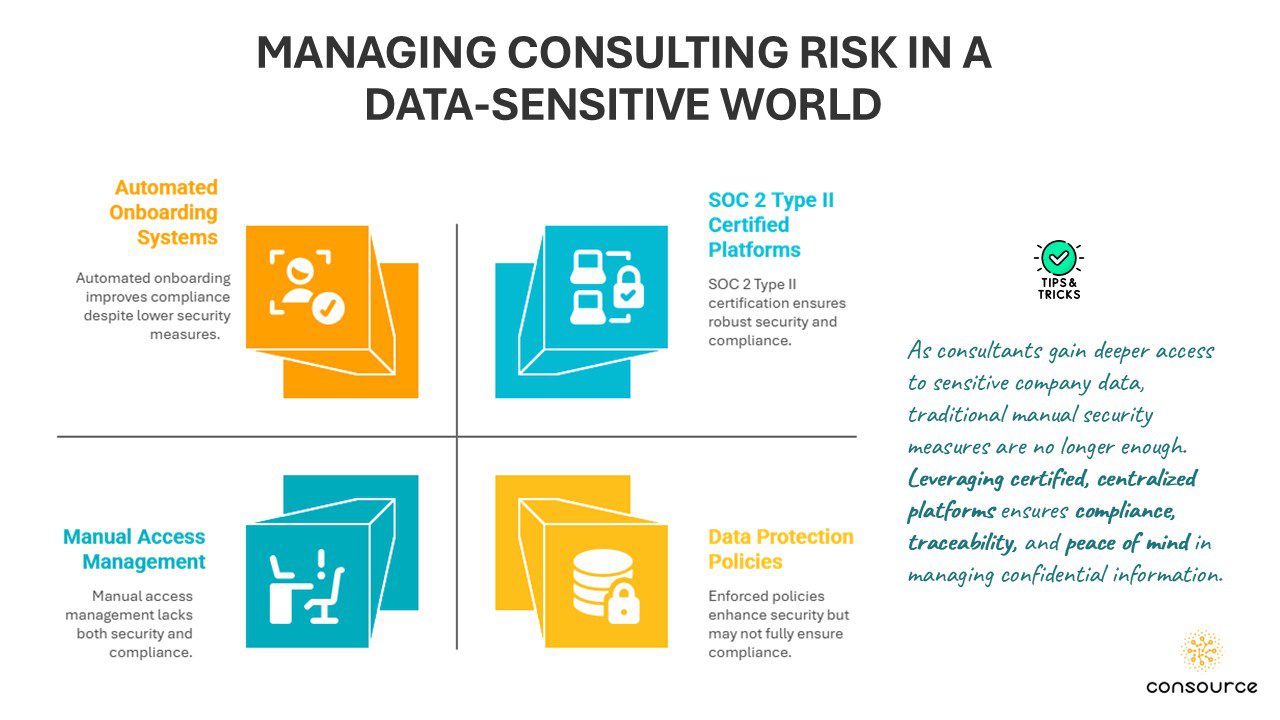
Pourtant, la plupart des entreprises continuent :
- Échange d'e-mails relatifs aux accords de confidentialité
- Partager des données confidentielles via des canaux ad hoc
- Équipes de consultants embarqués manuellement
- Manque de visibilité sur qui a accès à quoi
Compte tenu du contexte réglementaire et de la confidentialité des données actuels, ce n'est pas seulement un risque, c'est une grenade dont la goupille de sécurité est tordue.
C'est ici que Environnement certifié SOC 2 Type II de Consource devient crucial :
- Stockage sécurisé des données
- Contrôle d'accès via SSO (Okta)
- Traçabilité prête pour l'audit
- Collaboration centralisée et sécurisée
Vous ne devriez pas avoir à prier pour que vos consultants stockent correctement vos données. Une plateforme devrait s'en charger pour vous.
1.6. Le moment “ Et si... ” : lorsque l'auditeur arrive
Tout semble aller bien... jusqu'à ce que quelqu'un demande :
- “ Où est le contrat signé ? ”
- “ Qui a approuvé cette prolongation ? ”
- “ Pourquoi ce fournisseur a-t-il été sélectionné ? ”
- “ Où se trouve l'historique des versions du cahier des charges ? ”
- “ Montrez-nous la piste de validation. ”
- “ Pourquoi ces accords de confidentialité n'ont-ils pas été traités officiellement ? ”
Si la réponse à ces questions implique :
- fouiller dans les e-mails,
- demander aux personnes qui sont parties il y a 9 mois, ou
- faisant défiler les discussions Teams comme un archéologue…
… c'est trop tard.
À ce stade, vous n'avez pas besoin d'un processus, vous avez besoin d'un miracle.
Et c'est précisément pour cette raison que le conseil en matière d'approvisionnement nécessite une nouvelle approche.
Pas de règles plus strictes. Pas de politiques plus longues. Pas plus de listes de contrôle.
Ce dont le conseil a besoin, c'est :
- Visibilité
- Traçabilité
- Flux de travail cohérents
- Conformité intégrée
- Collaboration sécurisée
- Gouvernance centralisée
En d'autres termes : le conseil a besoin de ce que Consource a été littéralement conçu pour offrir.
Maintenant que nous avons parcouru la zone dangereuse, passons à la section 2.
2. Le théâtre de la conformité : quand les politiques existent (mais que personne ne les lit)
Si la section 1 traitait des risques cachés dans les opérations quotidiennes, la section 2 traite des risques que nous inscrivons dans nos propres contrats. Car voici la vérité dérangeante : dans le domaine des achats de services de conseil, de nombreux problèmes de conformité ne proviennent pas d'un comportement inapproprié de la part des consultants. Ils proviennent des entreprises qui rédigent des contrats totalement déconnectés de la réalité du travail de conseil.
Nous le voyons tous les jours. Des contrats conclus pour la fabrication, l'ingénierie, la logistique, les abonnements SaaS... tout. mais services spécialisés. Les équipes chargées des achats prennent le “ modèle standard ” de leur entreprise, y apportent quelques modifications cosmétiques, et voilà : un contrat de consultation qui est 60% hors de propos, 30% inapplicable et 10% carrément dangereux.
2.1. Le problème lié à l'utilisation d'un contrat d'activité principale pour une entreprise créative
La plupart des modèles de contrats des entreprises ont été conçus pour des livrables tangibles : machines, pièces détachées, produits chimiques, biens numériques. Ils partent du principe que :
- propriété claire des actifs produits,
- résultats de fabrication reproductibles,
- spécifications techniques mesurables,
- les défauts physiques potentiels et leurs solutions.
Le conseil, cependant, produit quelque chose de très différent : expertise, analyse, méthodologies, cadres, recommandations et parfois propriété intellectuelle originale. Essayer d'appliquer des clauses de type industriel au domaine du conseil revient à mettre une ceinture de sécurité à un poisson. Cela peut sembler responsable, mais cela reste absurde.
Examinons les suspects habituels.
2.2. Clauses relatives à la propriété intellectuelle : quand la logique industrielle se heurte à la réalité du conseil
L'une des erreurs les plus courantes que nous constatons est la clause relative aux “ droits illimités sur les résultats ”, qui exige que le consultant cède tout IP impliqué dans le projet, y compris les méthodologies préexistantes.
Pour un fournisseur industriel, cela est tout à fait logique.
Pour une société de conseil, c'est une menace existentielle.
Les consultants ne fournissent pas seulement leur travail ; ils fournissent des cadres, des outils de diagnostic, des méthodologies de benchmarking, des approches exclusives... la “ recette secrète ”. Leur demander de renoncer à cela revient à demander à un restaurant Michelin de vous donner ses recettes et le code source de ses fours.
Cela n'arrivera pas, et tout le monde le sait.
Que se passe-t-il alors ? La clause reste en vigueur, les consultants signent quand même et tout le monde s'engage tacitement à ne jamais l'invoquer. Ce n'est pas de la conformité. C'est un déni collectif.
2.3. Droits d'audit : importants en théorie, impossibles en pratique
Les clauses d'audit sont un autre domaine où les bonnes intentions sont détournées pour devenir absurdes.
Certains modèles industriels ou financiers accordent au client un large accès à :
- documents financiers,
- fichiers de projet,
- outils internes,
- et — attendez la suite — “ les travaux effectués pour d'autres clients ”.”
Aucun cabinet de conseil réputé n'acceptera jamais de donner accès au travail d'autres clients.
Et aucune équipe juridique ne s'y attend vraiment.
Mais la clause reste en vigueur parce qu“” elle a toujours été là ».”
Le résultat ?
Équipes chargées des achats penser ils ont des droits d'audit.
Consultants savoir ces droits ne seront jamais exercés.
Et la conformité devient un théâtre où les deux acteurs font semblant de suivre un scénario auquel personne ne croit.
2.4. Clauses de non-concurrence : générales, vagues et totalement inapplicables
Voici un autre exemple intéressant : les entreprises qui insèrent des clauses de non-concurrence ou d'exclusivité générales qui :
- ne sont pas limités dans le temps,
- ne précisez pas la géographie,
- ne définissez pas la portée du marché,
- et s'appliquent parfois à des secteurs entiers.
Cela peut sembler solide sur le papier, mais juridiquement, cela relève davantage de la fiction. Dans la plupart des juridictions, y compris en France et dans une grande partie de l'UE, une clause qui est disproportionnée, impossible à exécuter ou juridiquement défectueuse est considérée comme “ non écrite ” (comme si elle n'avait jamais été écrite).
Que se passe-t-il alors ?
Les consultants signent des contrats contenant des clauses dont tout le monde sait qu'elles ne résisteront pas à un examen juridique. L'entreprise pense être protégée, mais en réalité, elle n'a aucune protection.
Ce n'est pas de la conformité. C'est de la pensée magique.
2.5. Responsabilité : le risque illimité qu'aucun consultant n'acceptera vraiment
Rien ne pousse un partenaire consultant à se saisir plus rapidement de sa balle anti-stress qu'un contrat exigeant :
- responsabilité illimitée,
- responsabilité “ égale à l'impact total du projet ”,”
- ou responsabilité liée aux “ conséquences indirectes ”.”
Pour les fournisseurs industriels susceptibles de causer des dommages physiques ou financiers, cela est logique. Pour les consultants qui offrent leur expertise, cela est déraisonnable. La plupart des entreprises réputées accepteront des plafonds de responsabilité à :
- un multiple des frais de projet,
- ou un plafond monétaire fixe.
Tout ce qui dépasse ce cadre constitue soit un point de départ pour la négociation, soit un signal d'alarme. Pourtant, de nombreuses entreprises continuent d'imposer une responsabilité illimitée aux cabinets de conseil, contraignant les petits fournisseurs à accepter des conditions qu'ils ne peuvent pas absorber.
Ironiquement, cela ne réduit pas le risque, mais l'augmente. Un fournisseur qui sait que la clause est inapplicable est déjà en infraction dès le moment où il la signe. Aucun auditeur ni aucun juge ne la fera respecter, et les deux parties le savent.
Encore une fois : le théâtre de la conformité.
2.6. Le coût caché : quand tout le monde signe des contrats auxquels il ne croit pas vraiment
Le plus gros problème lié aux clauses contractuelles irréalistes n'est pas d'ordre juridique, mais opérationnel.
Quand les contrats deviennent absurdes :
- Les parties prenantes cessent de les lire.
- Les fournisseurs cessent de leur faire confiance.
- Le service des achats cesse de les appliquer.
- La conformité cesse de leur faire confiance.
- Les équipes juridiques commencent à lever les yeux au ciel.
Le contrat devient une formalité, et non plus une garantie.
Et l'entreprise perd la capacité de contrôler réellement ses dépenses en matière de conseil.
Vous vous retrouvez avec des fournisseurs qui fonctionnent sur la base d'une confiance mutuelle plutôt que d'attentes documentées, ce qui fonctionne... jusqu'à ce que cela ne fonctionne plus.
2.7. Pourquoi cela se produit-il ? Absence de gouvernance spécifique à chaque catégorie
Le conseil en matière d'approvisionnement est encore une discipline récente. De nombreuses organisations ne disposent pas :
- modèles spécifiques à une catégorie,
- cadres IP définis,
- droits d'audit réalistes,
- clauses de confidentialité adaptées,
- structures de responsabilité adaptées aux consultants,
- ou des mécanismes de conformité alignés sur les prestations de services.
C'est pourquoi le décalage persiste : les achats appliquent une logique industrielle à une catégorie de services intellectuels.
Bonne nouvelle : c'est précisément cette lacune que Consource comble.
En intégrant des flux de travail cohérents, en normalisant la documentation, en appliquant les dépendances et en fournissant un espace numérique spécialement conçu pour services basés sur la connaissance, Consource aide à éliminer l'ambiguïté avant qu'elle ne devienne un risque.
Et comme la plateforme centralise toutes les validations, versions, accords de confidentialité et approbations, la conformité devient enfin quelque chose que vous pouvez prouver, pas quelque chose que vous espérez.
3. La méthode Consource : instaurer une véritable gouvernance dans les achats de services de conseil
Nous avons désormais établi que les achats dans le domaine du conseil sont souvent régis par des processus conçus pour un autre siècle et des contrats rédigés pour une autre catégorie. Les défaillances en matière de risque et de conformité ne sont généralement pas spectaculaires ; elles sont structurelles. Elles se produisent discrètement, car les systèmes, les modèles et les flux de travail n'ont pas été conçus à l'origine pour le conseil.
Entrer Consource — la première plateforme spécialement conçue pour apporter une véritable gouvernance, visibilité et conformité aux achats de services de conseil. Non pas en alourdissant la bureaucratie, mais en orchestration intelligente, règles intégrées, et automatisation qui empêche les erreurs avant qu'elles ne se produisent.
Si l'approvisionnement traditionnel consiste à “ cocher des cases ”, Consource vise à “ éliminer les risques ”. Voyons comment.
3.1. Du chaos au contrôle : un parcours d'admission unique et traçable
La première raison pour laquelle les achats de services de conseil explosent est qu'il n'existe pas de processus d'admission standardisé. Chacun fait ce qu'il veut. Avec Consource, c'est fini.
Chaque projet, de la plus petite mission de conseil au programme de transformation de plusieurs millions, passe par un flux d'admission unifié:
- contrôle d'accès basé sur les rôles grâce à une authentification sécurisée (Okta SSO)
- Obligation de remplir les éléments clés de conformité (accord de confidentialité, déclaration de conflit d'intérêts, hiérarchie d'approbation)
- acheminement automatisé vers les services achats, juridique ou financier en fonction des caractéristiques du projet
- soumissions traçables avec horodatage, propriétaires et historique complet des audits
Ce n'est pas “ un outil de plus ”.”
C'est une barrière qui garantit discrètement qu'aucun projet malveillant ne s'introduise dans l'entreprise.
Vous n'avez pas besoin de surveiller les gens : la plateforme rend tout simplement impossible tout manquement aux règles.
3.2. NDA et gouvernance de la confidentialité qui fonctionne réellement
L'une des erreurs de conformité les plus courantes est la mauvaise gestion des accords de confidentialité (NDA) : signature tardive, stockage aléatoire ou “ omission temporaire parce que le consultant commence déjà lundi ”.”
Consource résout ce problème en automatisant la gestion des accords de confidentialité de bout en bout :
- Modèles NDA intégrés dans les flux de travail
- signature obligatoire avant d'accéder aux documents
- stockage sécurisé dans une architecture multi-locataires basée dans l'UE
- contrôle des versions et rappels automatiques pour les expirations
- traçabilité complète pour les audits
Cela évite d'avoir à envoyer des e-mails de suivi maladroits tels que :
“ Avons-nous déjà signé l'accord de confidentialité avec ce fournisseur ? ”
Maintenant, vous toujours savoir.
3.3. Modèles standardisés prêts à l'emploi pour les consultants qui empêchent la fiction juridique
Comme nous l'avons vu dans la section 2, les modèles de contrats génériques créent des risques de conformité ingérables et irréalistes. Consource résout ce problème en proposant des modèles spécifiques à chaque catégorie. pour le conseil:
- Clauses IP réalistes distinguant le contenu préexistant du contenu créé dans le cadre du projet
- droits d'audit pratiques adaptés aux prestataires de services
- limites de responsabilité raisonnables et applicables
- structures de confidentialité alignées sur la dynamique des services experts
- champs d'application de l'exclusivité ou de la non-concurrence soigneusement définis pour garantir leur applicabilité juridique
Au lieu de contraindre les fournisseurs à signer des contrats dont tout le monde sait qu'ils sont inutilisables, Consource vous aide à créer des documents que les deux parties comprennent et peuvent réellement respecter.
Cela réduit le risque juridique non pas en “ se montrant intransigeant ”, mais en aligné.
3.4. Finis les cahiers des charges manquants, les e-mails perdus ou les approbations invisibles
Les projets de conseil sont connus pour leur documentation dispersée. Consource résout ce problème grâce à une gouvernance centralisée et structurée des documents :
- Toutes les versions du cahier des charges stockées dans un dossier de projet unifié
- suivi automatique des modifications, commentaires et approbations
- joindre obligatoirement les documents clés avant de passer aux étapes suivantes
- workflows de validation intégrés (approvisionnement, juridique, financier)
- rappels de conformité intégrés en cas d'absence de documents requis
C'est là que Consource surpasse discrètement la plupart des outils généraux de technologie d'approvisionnement : il comprend qu'un cahier des charges de consultation n'est pas un “ document ”, mais un artefact de risque. Et il le traite en conséquence.
Vous gagnez en visibilité.
Les auditeurs bénéficient d'une traçabilité.
Personne n'a de surprises.
3.5. Conformité intégrée : des garde-fous sans bureaucratie
L'une des plus grandes craintes des acteurs économiques est que les outils d'approvisionnement ralentissent tout. Consource répond à cela par un principe simple :
La gouvernance doit être invisible, et non invasive.
La plateforme automatise les étapes de conformité afin que les équipes n'aient pas à s'en soucier :
- champs obligatoires pour la portée, les livrables, la méthodologie, la dotation en personnel
- processus d'approbation basés sur les risques qui s'adaptent à la complexité des projets
- contrôles automatisés pour la qualification des fournisseurs, les COI et les certifications
- déclencheurs de workflow pour examen juridique en fonction du type de projet ou du niveau de dépenses
Si un projet est risqué, Consource le valorise.
Si c'est une routine, Consource l'accélère.
Les parties prenantes n'ont pas besoin de se souvenir des règles : la plateforme les applique.
3.6. Sélectionner les fournisseurs avec intelligence, et non par instinct
De nombreux échecs en matière de sourcing consultatif proviennent d'une sélection incohérente des fournisseurs. Consource apporte de la transparence à cette étape grâce à :
- informations consultables sur les fournisseurs
- historique des performances et indicateurs clés de performance
- Domaines d'expertise vérifiés
- réalisations du projet
- conflits d'intérêts documentés
- processus RFx standardisés
En d'autres termes : fini les “ je connais quelqu'un qui connaît quelqu'un ”.”
La sélection des fournisseurs devient justifiable, fondée sur des données et documentée.
C'est le type de gouvernance dont rêvent vos auditeurs internes.
3.7. Traitement sécurisé des données : conçu pour un monde où les violations de données sont les nouveaux procès
Les consultants ont accès à des données sensibles, souvent plus que les employés. Consource aborde ce problème de front avec :
- Systèmes certifiés SOC 2 Type II couvrant la sécurité, la disponibilité, l'intégrité, la confidentialité et la protection de la vie privée
- données hébergées dans un stockage multi-locataires sécurisé basé dans l'UE
- contrôle d'accès et autorisations clairs
- journaux pour chaque consultation et action effectuée sur un document
- Intégration avec les systèmes d'entreprise pour une gestion unifiée des identités (Okta SSO)
Ce n'est pas seulement “ agréable à avoir ”.”
Avec le durcissement des réglementations mondiales, cela fait toute la différence entre être en conformité et faire la une des journaux pour toutes les mauvaises raisons.
3.8. Un cadre de gouvernance qui vous protège même si les personnes changent de rôle
Le roulement du personnel est un multiplicateur de risques, en particulier dans le domaine des achats de services de conseil, où les connaissances tacites se trouvent souvent dans les boîtes de réception. Consource résout ce problème en capturant :
- décisions
- validations
- négociations
- produits livrables
- évaluations de performance
- modifications contractuelles
…le tout dans un espace permanent, centralisé et consultable.
Si quelqu'un quitte l'entreprise, vous ne perdez pas le contrôle.
Si un auditeur arrive, vous ne perdez pas le sommeil.
Voici à quoi ressemble la mémoire institutionnelle dans une fonction d'approvisionnement moderne.
3.9. Et puis, il y a l'impact sur le risque : moins de surprises, plus de contrôle
La somme de toutes ces fonctionnalités est simple mais puissante :
Consource réduit activement les risques en rendant la non-conformité techniquement impossible, et non pas simplement “ découragée ”.”
Il transforme la gouvernance d'une politique PDF en un système vivant et opérationnel.
Soudainement :
- les projets malhonnêtes disparaissent
- les contrats irréalistes sont remplacés par des contrats réels
- la documentation est complète et traçable
- les étapes de conformité se déroulent automatiquement
- la sélection des fournisseurs devient défendable
- l'accès aux données est contrôlé
- les audits deviennent faciles
Ce n'est pas de la magie.
C'est un choix délibéré.
4. Risque ≠ bureaucratie : comment favoriser l'innovation sans perdre le contrôle
L'une des idées fausses les plus tenaces dans le domaine des achats de services-conseils est la croyance selon laquelle la gestion des risques et l'innovation sont des ennemis naturels. Si vous voulez de la créativité, vous devez accepter le chaos. Si vous voulez de la conformité, vous devez accepter la lenteur. C'est la version corporative de “ on ne peut pas avoir le beurre et l'argent du beurre ”.”
Mais voici la vérité dont les équipes d'approvisionnement sont rarement reconnues :
Une gouvernance intelligente ne freine pas l'innovation, elle la protège.
Et le conseil, avec ses missions stratégiques et sa grande visibilité, est précisément le domaine où vous avez besoin d'un système qui libère les équipes pour qu'elles puissent innover. sans transformant votre organisation en une cible potentielle pour les incidents de sécurité.
Voyons comment Consource rend cela possible.
4.1. Lorsque la gouvernance est invisible, elle cesse d'être l'ennemie
La raison pour laquelle les parties prenantes s'opposent aux règles d'approvisionnement n'est pas parce qu'elles détestent la conformité. C'est parce que les processus traditionnels les y obligent :
- rechercher des modèles,
- envoyer des e-mails pour obtenir des autorisations,
- attendre plusieurs jours pour obtenir un retour,
- se souvenir de plusieurs politiques,
- et répétez cinq fois la même information.
En d'autres termes : la gouvernance est perçue comme une punition.
Consource renverse cette dynamique en Intégrer la conformité dans des flux de travail intuitifs. Au lieu de demander aux gens de suivre des règles, la plateforme :
- les invite automatiquement,
- les guide à travers ce qui est nécessaire,
- supprime les étapes manuelles,
- garantit que les documents requis ne peuvent pas être omis.
La gouvernance devient naturelle, discrète, presque invisible.
Le résultat ?
Les parties prenantes cessent d'essayer de contourner le système, car celui-ci fonctionne enfin. avec avec eux, pas contre eux.
4.2. “ Autonomie contrôlée ” : donner de la liberté aux équipes, dans le respect des limites fixées
Toute bonne organisation sait qu'il est impossible d'innover en microgérant. Mais vous ne pouvez pas non plus laisser chaque équipe fonctionner comme son propre univers d'approvisionnement.
Consource permet autonomie contrôlée à travers :
- flux de travail basés sur les risquesLes projets à faible risque avancent rapidement. Ceux à haut risque font l'objet d'un examen plus approfondi.
- chemins d'approbation dynamiques qui s'adaptent en fonction des dépenses, de la région, du fournisseur ou du type de projet.
- fournisseurs préapprouvés et modèles qui suppriment les frais généraux liés à la négociation.
- seuils de politique configurables la gouvernance est donc adaptée, et non dogmatique.
C'est comme si vous donniez les clés à vos parties prenantes, mais la voiture ne démarrera pas tant qu'elles n'auront pas bouclé leur ceinture de sécurité.
4.3. Prévenir les risques à temps : des alertes avant que les erreurs ne deviennent des problèmes
La conformité traditionnelle est réactive :
quelque chose se casse, un auditeur le trouve, et tout le monde promet de faire mieux l'année suivante.
Consource est proactif. Il signale les problèmes. avant ils créent une exposition.
Exemples :
- Un périmètre sans livrables ? → signalé.
- Un fournisseur non qualifié pour un projet sensible ? → signalé à la hiérarchie.
- Un projet lancé sans accord de confidentialité ? → bloqué.
- Un contrat avec des signatures manquantes ? → suspendu jusqu'à ce que le problème soit résolu.
- Une incompatibilité entre les versions SOW ? → détectée automatiquement.
- Un dépassement budgétaire basé sur les factures précédentes ? → prévu à l'avance.
En bref : Consource détecte les erreurs que les humains ne peuvent s'empêcher de commettre, non pas en surveillant, mais en éliminant le risque dès la conception.
4.4. Gestion de la performance : l'outil de conformité dont personne ne parle
La conformité n'est pas seulement une question juridique. Il s'agit également de s'assurer que le cabinet de conseil tient réellement ses promesses.
Consource comprend un suivi intégré des performances qui vous permet de documenter :
- qualité de livraison,
- respect du champ d'application,
- précision de la chronologie,
- cohérence du personnel,
- efficacité du transfert de connaissances.
Cela crée une boucle de rétroaction qui :
- réduit le risque d'échec du projet,
- améliore la responsabilité des fournisseurs,
- informe les sélections futures,
- renforce le pouvoir de négociation.
Il s'agit d'un mécanisme de conformité qui passe inaperçu, et dont les outils d'approvisionnement généraux ne tiennent jamais compte.
4.5. Favoriser la rapidité sans compromettre la sécurité
C'est là que Consource devient véritablement un partenaire stratégique. La rapidité et la sécurité ne doivent pas nécessairement être incompatibles. En fait, Consource les rend complémentaires :
- Admission plus rapide → moins de projets parallèles
- Accès instantané aux modèles → moins de révisions juridiques
- Signatures et flux de travail automatisés → moins de retards
- Visibilité en temps réel de l'état → moins de suivis
- Documents centralisés → moins de goulots d'étranglement
- Flux d'approvisionnement guidés → moins d'erreurs
La plateforme élimine les frictions du processus, mais pas le jugement de la gouvernance.
Les parties prenantes gagnent en rapidité.
Les achats garantissent la conformité.
Les cadres bénéficient d'une transparence totale.
Les auditeurs obtiennent des preuves.
Et plus personne n'aura à envoyer de “ rappels amicaux ”.
4.6. Le paradoxe de l'innovation : vous ne pouvez avancer rapidement que si vos fondations sont solides
Les organisations pensent souvent que supprimer la gouvernance accélère l'exécution. Ce n'est pas le cas. Cela accélère échec.
Sans garde-corps :
- les fournisseurs ne sont pas alignés,
- dérive budgétaire,
- les champs d'application changent,
- la confidentialité est compromise,
- et la valeur du projet s'en trouve diluée.
Si vous voulez innover, vous avez besoin d'une structure. Et Consource vous offre exactement le type de structure dont l'innovation a besoin :
- lumière,
- flexible,
- intelligent,
- automatisé,
- adapté au conseil,
- favorable plutôt que restrictif.
C'est le contraire de la bureaucratie.
C'est de la chorégraphie.
4.7. Une catégorie conçue pour l'expertise humaine nécessite également une plateforme conçue à cet effet.
Les secteurs industriels peuvent tolérer un peu de chaos. Le conseil, non.
Ses risques sont d'ordre réputationnel, stratégique, politique, intellectuel — et pas seulement financier.
Consource apporte professionnalisation à un domaine qui s'est longtemps appuyé sur l'intuition et des processus fragmentés. C'est ce qui permet à l'entreprise d'innover en toute confiance, sachant que :
- les bons consultants sont sélectionnés,
- les bons documents sont signés,
- les données appropriées sont protégées,
- les autorisations nécessaires sont en place,
- la bonne performance est suivie,
- et que les risques appropriés sont maîtrisés.
Tout en permettant aux équipes d'avancer plus rapidement que jamais.
Car la vitesse sans contrôle n'est pas synonyme d'innovation, mais plutôt de pari risqué.
Conclusion — La fin du chaos dans le domaine du conseil (et le début d'un véritable contrôle)
Le risque dans les marchés publics de services de conseil n'a jamais été lié à des personnes malveillantes, à la négligence ou à des échecs spectaculaires. Il s'agit plutôt de systèmes qui n'ont jamais été conçus pour un monde où la stratégie est externalisée, l'expertise louée et la transformation dépendante de personnes qui ne travaillent pas pour vous.
Depuis des années, les organisations tentent de gérer leurs achats de services de conseil à l'aide :
- outils conçus pour l'achat de biens,
- contrats rédigés pour des contextes industriels,
- des workflows d'approbation mieux adaptés aux frais de déplacement,
- cadres de gouvernance fondés sur l'hypothèse que les consultants se comportent comme des fournisseurs de mobilier de bureau.
Pas étonnant que la conformité ressemble à du théâtre et que le risque ressemble à la roulette.
Mais rien de tout cela n'est inévitable. C'est pourquoi les achats de services de conseil ne peuvent plus être considérés comme une activité administrative. À grande échelle, les services de conseil en matière d'approvisionnement méritent votre attention en tant que discipline stratégique au niveau exécutif. Le conseil peut être complexe, mais il n'est pas ingérable. Le problème a toujours été structurel, ce qui signifie que la solution doit également être structurelle.
Et c'est là que Consource intervient. Il fait entrer le conseil en achats dans l'ère moderne grâce à :
- un processus centralisé qui bloque les projets non autorisés avant même leur lancement,
- des modèles spécifiques à chaque catégorie qui concilient la réalité juridique et les besoins opérationnels,
- une gouvernance automatisée qui élimine les erreurs humaines et les frictions,
- infrastructure sécurisée certifiée SOC 2 Type II pour la protection des données,
- suivi des performances qui permet de choisir plus judicieusement les fournisseurs à chaque fois,
- et des flux de travail qui guident les gens sans les ralentir.
Cela n'ajoute pas de bureaucratie. Cela remplace l'improvisation par l'intelligence. Cela n'impose pas de règles. Cela intègre silencieusement des garde-fous dans le processus. Cela ne réduit pas l'innovation. Cela la protège en donnant aux équipes la confiance nécessaire pour agir rapidement sans mettre l'entreprise en danger. Et surtout, Consource.io transforme la consultation en matière d'approvisionnement, qui était auparavant une activité réactive consistant à rechercher des documents, en une activité discipline stratégique, régie et axée sur la perspicacité où le risque est minimisé, la conformité est naturelle et la création de valeur devient prévisible.
Les achats de services de conseil comportent toujours une part d'incertitude : après tout, vous achetez de l'expertise, pas du matériel. Mais avec Consource.io, l'incertitude cesse d'être un danger et devient un paramètre de conception. Quelque chose que vous gérez de manière intentionnelle, transparente et durable. C'est à cela que ressemble la gouvernance moderne. C'est ainsi que devrait être la gestion des risques. Et c'est ce que Consource livre.
Prêt à gérer intelligemment les risques liés au conseil ?
Si vous souhaitez découvrir comment Consource transforme votre sourcing de conseil, passant d'une approche hasardeuse à une approche prête pour l'audit, rien ne vaut de le voir en action.
👉 Réservez une visite guidée gratuite de Consource et découvrez comment la plateforme peut vous aider :
- éliminer les projets malveillants,
- normaliser la documentation,
- assurer la conformité sans difficulté,
- sécurisez vos données,
- et réduisez les risques dans l'ensemble de votre portefeuille de services de conseil.
Élaborez une stratégie. Achetez. Livrez.
Ce n'est pas seulement un slogan, c'est la manière dont fonctionne enfin l'approvisionnement en services de conseil.



0 commentaires