
Large organisations usually know they spend a great deal on consulting. What they often lack is a consolidated view of where that spend sits, how quickly it is growing, and how often similar work is being commissioned in parallel across different parts of the business.
The reason is not especially mysterious. Consulting demand does not present itself as a single category waiting to be managed neatly. It appears through transformation programmes, capability gaps, regulatory pressure, and the recurring discovery that an important issue has become urgent rather sooner than anyone claims to remember. The difficulty begins when these decisions accumulate without much visibility across the whole.
For business leaders, the result is a familiar imbalance. Consulting is approved one project at a time, while cost, supplier exposure, and duplication build up at portfolio level. Scope is often shaped before alternatives are properly compared. Spending is then examined most closely once it has already become contractual, a sequence that tends to flatter process while doing less for control.
That is why consulting spend management has become a leadership issue. How finance leaders can bring structure, visibility, and ROI discipline to consulting spend is outlined in Consource for Finance Leaders.
The question is no longer whether external expertise has a role; in most large organisations, it plainly does. The question is whether business leaders have enough visibility, structure, and selectivity to manage consulting spend as an investment category rather than as a sequence of urgent decisions that become rigorous mainly once they are difficult to change.
Where consulting spend management becomes difficult to control
In most large organisations, consulting spend becomes difficult to control because it is commissioned locally and seen centrally only in part. Different teams buy for reasons that may be perfectly valid, but the aggregate picture forms later and usually with less clarity than a category of this size should permit.
Demand appears project by project
Consulting demand does not arrive as a portfolio waiting to be managed. It emerges through transformation work, strategic reviews, digital programmes, integration efforts, and capability gaps that require external support. Each mandate can make sense on its own. The difficulty is that these decisions are rarely taken with a clear view of what is already being commissioned elsewhere in the business.
That leaves some fairly basic questions harder to answer than they should be:
- Where is consulting spend increasing?
- Which firms are being used repeatedly?
- How often is similar work being bought in parallel?
- Which mandates are genuinely distinct, and which have simply acquired different titles?
Familiar firms gain an advantage
When visibility is partial, supplier choice tends to favour firms that are already known. That is understandable enough. Known firms are easier to mobilise, easier to explain internally, and less likely to slow the project down with an extended comparison exercise.
The difficulty is that familiarity can start to look more rigorous than it is. A supplier may appear to be the prudent choice when it is simply the least disruptive one.
The cost builds gradually
The financial effect usually comes through repetition, overlap, and weak comparison rather than through one obviously poor decision. That makes it less visible and, in practice, easier to tolerate for longer than it should be.
Typical consequences include:
- overlapping mandates across business units
- repeated use of the same suppliers without proper comparison
- inconsistent evaluation of proposals
- weaker leverage on pricing and scope
- limited reuse of knowledge from previous projects
- poor visibility on outcomes once delivery begins
What makes this difficult is not the existence of these issues individually, but the fact that they accumulate in a category that is expensive, strategic, and still too often managed in fragments.
Why the usual ways of managing consulting spend do not work very well
Most organisations do not neglect consulting spend. They review it, approve it, route it, document it, and sometimes surround it with enough workflow to suggest that the matter is under control. The difficulty is that these mechanisms often begin operating once the main decisions have already settled into place.
Approval often starts after the room for improvement has narrowed
In many companies, the approval process begins once the business need has already been framed, a supplier has already emerged, and the commercial terms are already moving in a fairly definite direction. At that stage, the project is still called a proposal, but in much the same way that a flight remains boardable once check-in has closed.
That timing matters because the main opportunities for optimisation sit further upstream. At project level, they concern scope, staffing, supplier selection, delivery approach, and pricing logic. At portfolio level, they concern demand management, make-or-buy choices, and the question of whether several mandates should be considered together rather than approved one by one in tidy isolation.
Once approval begins that late, most of that leverage has already weakened. The process can still authorise the spend, and sometimes delay it, but it is much less likely to improve it.
Generic procurement tools do not solve a consulting-specific problem
A second limitation is more structural. Consulting is one of the rare spend categories in which scope is not simply something to record; it is one of the things most in need of challenge.
That is because consultants are not commodities, however convenient that idea may occasionally seem from an administrative perspective. Two firms responding to the same brief may define the problem differently, structure the work differently, staff it differently, and produce very different levels of value. Those differences affect what the client is actually buying, how the work will be delivered, and what value it is likely to create.
This is where generic tools begin to lose their usefulness. They can record spend, route approvals, and store contracts perfectly well. What they do not do especially well is help the business decide whether the brief is framed properly, whether the right firms are being invited, whether proposals are genuinely comparable, or whether an elegant staffing model is simply a costly way of introducing junior consultants to your sector.
Incumbents benefit from weak competition and loose process discipline
Known firms often have a genuine advantage in consulting, and there is no reason to pretend otherwise. Client intimacy is real, and panels can make sense for the same reason: they create speed, continuity, and a degree of reassurance that large organisations are rarely eager to abandon.
The difficulty begins when that familiarity is allowed to do more work than it should. A commercially useful relationship starts to stand in for a proper comparison of alternatives, and continuity begins to count as proof of fit. At that point, the process may still look competitive, but not always in a way that puts much pressure on the result.
Where the scope is vague, the timetable compressed, or the evaluation criteria broad enough to accommodate almost any polished argument, familiar firms enjoy a clear advantage. Several suppliers may be invited, yet if one firm was always the expected winner, the competition has mainly served to make that preference look procedural.
Under those conditions, optimisation weakens from the start. Alternative firms are less likely to be taken seriously, pricing pressure softens, and loose scope has room to present itself as sophistication. The incumbent may still win on merit. It simply wins in an environment where familiarity has already done some of the work.
Why the process looks stronger than it is
Taken together, these patterns explain why consulting spend can look controlled without being especially well managed. The organisation has approvals, tools, and sourcing steps, all of which create a welcome appearance of order. What it often lacks is enough influence early in the cycle to shape either the project or the wider portfolio with much discipline.
The consequences are predictable enough. At project level, there is too little room to challenge scope, staffing, supplier selection, delivery model, or pricing logic once the process becomes visible. At portfolio level, there is too little ability to manage demand properly, to ask whether the work should be bought externally at all, or to notice that several supposedly distinct mandates bear a rather familiar resemblance to one another.
That is where the usual model shows its limits. The issue is not the absence of process. It is that process often enters once the useful choices have already been made elsewhere, sometimes carefully, sometimes hurriedly, and occasionally in the presence of a firm everybody was always going to hire anyway.
How business leaders can regain control of consulting spend
Regaining control of consulting spend does not begin with tighter approvals or more elaborate procurement choreography. It begins earlier, with a more disciplined view of demand itself. Before asking which consultants to use, or whether to launch a sourcing process at all, business leaders need to decide whether the underlying project is important enough to justify attention, budget, and organisational energy in the first place. That sounds obvious, which is usually a sign that companies are fully capable of overlooking it.
Start with the project, not the supplier
The first question is not whether external consultants are needed. It is whether the project is strategic enough to matter. That judgement comes before make-or-buy, because a weak initiative does not become more convincing simply because someone proposes to keep it in-house. A project should support business continuity, strategy and transformation, operational efficiency, or a genuinely necessary enabling role. If it sits comfortably in none of those categories, the business should at least hesitate before granting it the status of urgent necessity, which many internal initiatives acquire with suspicious ease.
Those categories also should not be managed under the same economic logic. Business continuity work is often treated, rightly or wrongly, on a whatever-it-takes basis, since the cost of failure is usually easier to imagine than the savings from restraint. Strategy and transformation projects require a clearer view of expected value, even if that value cannot always be reduced to a neat ROI line without making the exercise look more precise than it is. Operational efficiency work is usually easier to challenge, because the promise is more concrete; if the gains remain elusive after several workshops, one is entitled to ask what exactly is being made efficient. Enabling work is trickier, since it supports broader objectives rather than standing on its own, which is why it has a natural talent for sounding indispensable.
The point is not to create a grand taxonomy for its own sake. It is to filter demand before it hardens into budget. That means deciding what is essential, what is useful, what can wait, and what is still alive largely because last year’s budget gave it a respectable address. Historical spending is a poor guide here. It tends to reward the functions that already consume the most consulting and teaches them, rather effectively, that the safest way to protect next year’s room is to fill this year’s envelope.
Then ask how the work should be delivered
Once the project itself has passed that first test, the next question is delivery. Should the work be done internally, externally, or through some combination of the two? That is where make-or-buy becomes useful, provided it is asked at the right moment and not used to decorate a decision that has already been made.
External consultants can bring expertise the organisation does not have, capacity it does not have available, independence that may be politically useful, or acceleration where the cost of delay is high. All of that can be valid. None of it should be assumed. In many cases, the better answer is partial externalisation rather than full outsourcing: keep part of the work inside, bring in specialist support where it adds real value, and use the consulting market as an evolving value chain rather than as a single undifferentiated block of expensive intelligence.
That distinction matters because consulting is no longer one homogeneous offering, if it ever was. Strategy support, data expertise, implementation capacity, niche functional knowledge, transformation design, PMO reinforcement, and specialist advisory work do not all belong to the same economic or delivery logic. Yet organisations still behave, from time to time, as though one large firm ought naturally to cover the entire requirement. Large firms are often happy to encourage that view, which is understandable enough; they are not here to discourage revenue concentration on moral grounds. The more useful question for the client is whether the problem genuinely requires one integrated provider or whether different parts of the mandate call for different kinds of expertise. In most other sectors, a supplier claiming equal excellence across everything would at least invite a raised eyebrow. Consulting has enjoyed a rather generous exemption.
Only then does sourcing strategy become the real question
Once the business has decided that the project matters and that external support is justified, it can move to sourcing in a serious way. That means asking which expertise is actually required, which firms are credible for that scope, and whether the mandate should be split, sequenced, or structured around more than one provider. The whole project does not necessarily belong with one firm simply because one firm would find that arrangement very pleasing.
This is where many organisations still lose discipline. They move too quickly from “we need help” to “who do we already know,” which is efficient in a narrow sense and expensive in several wider ones. A better sourcing strategy begins from the work itself: what exactly needs to be solved, what kind of expertise is required, what level of seniority is justified, and which firms are genuinely suited to that combination. Only then does it become possible to compare proposals on grounds more serious than reputation, familiarity, or the general atmosphere of competence.
It also becomes easier to decide when competition matters and what kind of competition is useful. Not every mandate requires a multi-round process with enough documentation to qualify as minor literature. But where the stakes are meaningful, where the scope can be contested, or where the business may be defaulting toward a comfortable incumbent, competition is one of the few remaining ways to test whether confidence and fit are, in fact, the same thing. They are not always close relations.
Intimacy with consultants is useful; it is not a sourcing strategy
Relationships with consulting firms are not a problem in themselves. On the contrary, client intimacy can be extremely valuable. A firm that knows the organisation well may start faster, navigate complexity more effectively, and require less expensive time spent learning how decisions are really made, as opposed to how the governance manual claims they are made. In high-stakes situations, or where speed matters, that familiarity may have real economic value.
The mistake is to treat that familiarity as the starting point of the sourcing strategy rather than as one factor in the evaluation. A known firm may well deserve to win. It simply should not win because the organisation has quietly decided, before the process begins, that familiarity settles the matter. Panels can be very useful for similar reasons: they create speed, continuity, and some discipline in market access. They can also narrow the field too early, or preserve relationships beyond the point at which they remain the best answer. The fact that a firm is easy to call is not, by itself, a compelling category strategy.
The real shift is from processing demand to governing it
This is the broader change business leaders need to make. Consulting spend is not best managed as a stream of incoming requests to be processed with increasing elegance. It has to be governed earlier, with a clearer view of strategic importance, delivery choices, and sourcing logic. That is the only way to improve both the individual project and the portfolio as a whole.
Seen in that light, control becomes less bureaucratic and more managerial. The business asks first whether the project deserves to exist, then how it should be delivered, and only then how external expertise should be sourced if external expertise is in fact the answer. That sequence is more demanding, but also more rational. It avoids the common habit of starting with supplier discussions before anyone has fully agreed on the nature of the problem, which is an excellent way to generate motion and a less reliable way to produce judgement.
Where Consource fits
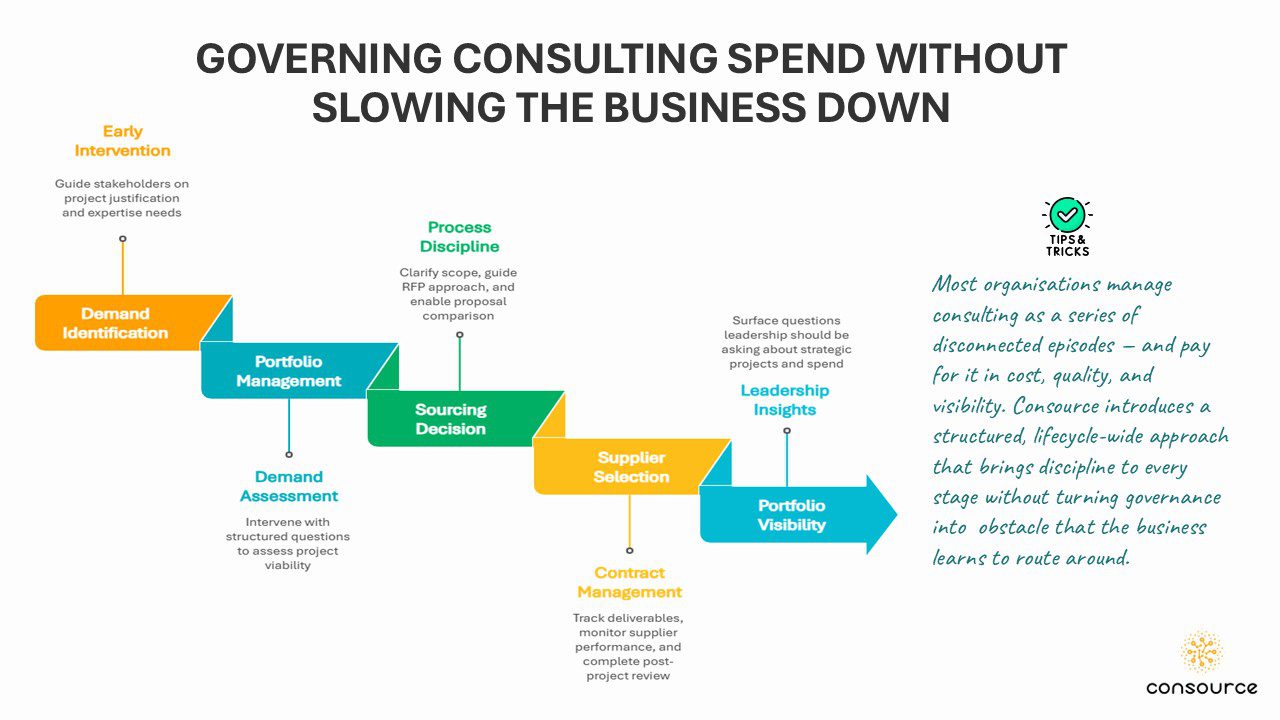
By this point, the question is no longer whether consulting spend needs more discipline, but how to introduce that discipline without slowing decisions to the point where the business starts treating governance as a nuisance. That is where Consource provides a consulting-specific layer across the full lifecycle, from demand and sourcing to project follow-up and closure, so that consulting can be managed as a continuous process rather than as a sequence of loosely connected episodes.
From demand to delivery
One of the recurring problems in consulting spend is that each phase tends to sit in a different place. Demand emerges in the business. Sourcing happens somewhere between the business and procurement. Project follow-up, if it happens properly, takes place elsewhere again. Closure often arrives quietly, usually with a final invoice and a sudden eagerness to discuss something else.
Consource helps connect those phases. It structures the path from the first expression of need to the sourcing decision, from sourcing to project execution, and from execution to closure and evaluation. That continuity matters because, without it, each stage may look reasonable on its own while the overall picture remains harder to see than it should be.
Managing consulting demand at portfolio level
A system is useful only if it helps when decisions can still be improved. In consulting, that means early: is the project strategic enough to justify external support, should the work be delivered internally or externally, what expertise is actually needed, and what kind of sourcing approach makes sense?
Consource helps guide stakeholders through those questions with more structure and consistency. That matters not only for procurement, but also for business leaders and budget owners who source consulting autonomously, which many do. In practice, organisations often rely on stakeholders who understand their business well but are not specialists in consulting sourcing, and who therefore approach the market with methods that are uneven at best.
Guiding both procurement and business stakeholders
Most organisations are trying to solve two problems at once: they want stronger control over consulting demand and supplier choice, but they do not want every mandate to disappear into a central process with the pace of a licensing office.
Consource helps procurement by adding structure, visibility, and consistency across the lifecycle, while also helping business stakeholders do things properly even when procurement is not leading every step. Procurement remains involved where it adds value: shaping the process, improving leverage, and bringing discipline to supplier comparison. It does not need to become the choke point through which all consulting decisions pass in single file.
Structuring sourcing decisions
Once the decision has been made to use external support, the next challenge is sourcing. This is where Consource becomes more than a visibility tool. It helps structure the sourcing process itself by clarifying scope, guiding the RFP approach, supporting proposal comparison, and improving the organisation’s ability to assess suppliers against the actual need rather than against brand familiarity alone.
A more disciplined sourcing process helps the business decide what expertise is needed, whether one firm or several firms should be considered, and how proposals should be compared in a way that reflects delivery logic rather than presentation quality.
Making portfolio visibility actionable
From a leadership perspective, one of the strongest reasons to have a platform like Consource is that it provides a more coherent view across the portfolio. Which projects are emerging? Which are strategic? Where is spend increasing? Which suppliers are being used repeatedly? Where is the organisation relying on familiarity when it would prefer to think of itself as relying on judgement? Why this lack of visibility remains a persistent issue for finance leaders is explored in CFO Consulting Procurement: The Blind Spot Costing You ROI.
These are basic questions in a category of this size. Yet in many organisations they remain oddly difficult to answer, because the information sits in too many places and arrives too late to be especially useful.
Keeping control after supplier selection
Another weakness in many consulting environments is that discipline fades after the firm has been selected. A great deal of attention goes into choosing the adviser, after which the organisation can become surprisingly relaxed about what happens next.
Consource extends structure beyond sourcing into execution and closure. That includes project follow-up, deliverable tracking, supplier performance, and post-project review. It helps keep the organisation interested once the statement of work has been signed, which is often when attention begins to migrate elsewhere.
Why this matters for business leaders
Seen from a business leader’s standpoint, the value of Consource is straightforward. It helps the organisation move from fragmented buying to governed decision-making. It brings more discipline to demand, more structure to sourcing, more continuity to project follow-up, and more visibility across the portfolio.
Which is useful, because “we more or less know what we are doing” is a charming sentiment, but an unnecessarily expensive operating model.
Conclusion
Consulting spend rarely escapes control in a dramatic way. It usually does so more quietly: one justified project at a time, one familiar firm at a time, one budget cycle at a time, until the organisation realises it has been buying consulting in fragments and reviewing the total afterwards. Read more to know how to in Maximizing Consulting ROI.
For business leaders, the issue is not whether consultants are useful. It is whether the company has a disciplined way to decide which projects matter, how they should be delivered, when external support is justified, and how firms should be selected once the answer is yes.
That is where Consource.io helps. It structures the full process, from demand and sourcing to project follow-up and closure, while guiding stakeholders to make better decisions even when they source consulting autonomously. Procurement remains involved, but without becoming the compulsory slow lane for every mandate.
The goal is not to buy less consulting for the sake of it. It is to buy it with more clarity, more selectivity, and less reliance on momentum dressed up as necessity.
Book a free walkthrough of Consource.io and see how your consulting procurement can finally work the way it should.
