
If you’ve ever tried to stretch a consulting budget across a transformation roadmap, you know the feeling. It’s a bit like hosting a dinner party for twenty with ingredients meant for six. You can get creative, you can get efficient… but sooner or later you realize you need a smarter plan than “hope for the best.”
Because here’s the truth every Strategy Leader, CFO, Transformation Officer, and CPO eventually confronts: Your ambitions are expansive. Your internal capacity is finite. And the consulting world is no longer a simple choice between “hire the big firm” or “do it ourselves.”
Today, consulting has become an investment portfolio — one where every project, supplier, and delivery model competes for your scarce capital and attention. Some bets pay off handsomely. Others drain resources with the elegance of a slow leak. And the organizations that win aren’t the ones spending the most; they’re the ones allocating the smartest.
But making consulting work for you — truly work — requires more than historical relationships, gut instinct, or the time-honored tradition of “who made the request the loudest.” It demands a system. A discipline. A way to decide where external expertise actually moves the needle, where internal teams should lead, and how you ensure that every consulting dollar generates a return you can stand behind in front of a board — or a particularly skeptical finance committee.
Fortunately, the consulting ecosystem has evolved. The days when your only options were mega-firms or nothing are gone. You now have boutiques, expert freelancers, embedded advisors, research platforms, and hybrid models that let you dial support up or down like a precision instrument. The lever is there — if you learn to pull it intentionally.
And that’s where the modern playbook begins: treating consulting not as tactical spend, but as a strategic investment class. One that can accelerate your roadmap, de-risk your toughest problems, and — when used well — even fund the next phase of your transformation.
Of course, that also means tracking performance, managing demand, and maintaining governance without becoming the corporate equivalent of airport security. The good news? Today’s digital tools make that easier than ever. Platforms like Consource help leaders centralize visibility, structure decision-making, and ensure that consulting dollars are invested with the same rigor as any other strategic asset — supported by secure, enterprise-grade foundations, including SOC2 and ISO certifications.
So consider this your strategic field guide. A sharp, pragmatic playbook for maximizing consulting ROI — written for leaders who refuse to treat consulting like a line item and instead treat it like the multiplier it can be.
Ready? Let’s start where all good investment strategies begin: understanding your portfolio.
1. The Strategic Utilization Challenge: Why Consulting Can’t Be Everywhere
Every transformation leader eventually discovers a universal truth: your roadmap is always bigger than your budget. It’s practically a law of corporate physics. You start the year with a bold agenda — new markets to explore, operations to streamline, digital capabilities to build, an organization to reshape — and within weeks, reality taps you on the shoulder and whispers, “Nice plan. Now choose.”
Because no matter how ambitious the vision, your team’s capacity is finite. And consultants, while powerful, are not the Swiss Army knife solution many business units wish they were. Yes, they can accelerate progress, bring expertise, and create momentum. But they can also burn through your budget with the appetite of a teenager discovering unlimited data for the first time.
Which leads to an uncomfortable question leaders must confront early:
Where does consulting truly lift performance — and where does it quietly drain ROI?
That question sits at the heart of strategic utilization.
1.1 The Resource–Ambition Gap (a.k.a. The Executive Reality Check)
Most organizations juggle a portfolio of 40, 60, sometimes over 100 initiatives. And while the strategy decks look clean and linear, execution never is. Internal teams are pulled into firefighting, BAU pressures, political alignments, or the delightful chaos that comes from attempting cross-functional collaboration.
So leaders face a choice:
- Under-resource initiatives and watch timelines slip,
- Overstretch teams and watch quality suffer,
- Or bring in consultants to fill the gaps.
The mistake? Assuming consultants are an all-purpose answer. In truth, indiscriminate consulting use dilutes ROI, erodes internal ownership, and often funds nice-to-have work simply because someone “had budget left.”
Strategic utilization flips the script: consultants don’t go where there is noise — they go where there is leverage.
1.2 The Evolution of Consulting Demand (and Why Your Old Playbook Doesn’t Work Anymore)
Remember when consulting used to be simple?
- Strategy gets written.
- A big firm gets hired.
- A team in matching laptops shows up for six months.
That era is gone.
Today’s strategies evolve continuously. Disruption is constant. Priorities shift quarterly, sometimes monthly. Your consulting model has to flex with the work — fast starts, rapid pivots, shorter cycles, modular expertise.
Meanwhile, the supply side has exploded into a diversified ecosystem:
- Global firms for large-scale transformation,
- Boutiques for niche expertise,
- Freelancers for agility,
- Marketplaces for on-demand talent,
- Research platforms for instant insights,
- Embedded advisors for continuity.
You’re no longer picking a firm; you’re designing an ecosystem. And ecosystems require orchestration — not reflexive spending.
1.3 You’re Not Buying a Firm Anymore — You’re Allocating Capital
This is the shift most organizations struggle with. Consultants are not “extra hands.” They are capital investments — strategic assets you deploy when the business case justifies the cost, the impact is real, and the timing is right.
In practice, that means:
- Choosing external vs. internal support based on impact, not habit.
- Prioritizing the initiatives that genuinely warrant external leverage.
- Avoiding the political trap of “every VP gets a project.”
- Making decisions with data instead of organizational folklore.
And here’s where the modern tools come in.
To treat consulting like an investment class, leaders need visibility — real visibility.
You need to see:
- What you’re spending,
- Where it’s going,
- Which suppliers deliver value,
- Which teams rely on consulting the most,
- Where ROI is being created (or quietly destroyed).
That’s the foundation Consource was built on. With centralized intake, spend analytics, supplier performance tracking, and project governance baked into a single platform, leaders finally get the transparency they need to use consulting strategically — not reactively. Consource supports this shift by giving Strategy Leaders a unified operating system for consulting decisions. This added visibility helps leaders move from reactive spending to intentional, data-driven allocation of consulting resources. All wrapped in secure, enterprise-grade architecture (SOC2 and ISO certified).
1.4 The Goal of Strategic Utilization
At its core, strategic utilization sounds deceptively straightforward:
Deploy the right consulting support, on the right initiatives, at the right time — using the right delivery model.
Elegant, yes. But in practice? It’s where most organizations quietly lose millions.
Because without structure, “consulting utilization” becomes a patchwork of ad-hoc decisions: a VP who urgently wants external help to “benchmark our digital maturity,” a transformation team scrambling to meet deadlines, a project owner who didn’t know internal resources existed, and a procurement team trying to impose order on a parade that’s already halfway down the street.
Strategic utilization brings coherence to this chaos. It forces leaders to ask the harder questions:
- What problems truly deserve external expertise?
- Which initiatives would be just as effective — or more — if owned internally?
- Where does consulting amplify value, and where does it mask deeper organizational gaps?
- How do we balance speed, cost, capability building, and political reality?
And importantly:
How do we make these decisions consistently — not based on who has the ear of the CEO or who had leftover budget in Q4?
When done well, strategic utilization becomes the connective tissue between strategy, finance, and execution. It ensures that consulting isn’t a crutch, a luxury, or a wildcard — but a deliberate lever tied to measurable impact.
This mindset is the foundation for everything that follows.
2. Mapping Your Strategy-to-Execution Pipeline for Maximum ROI
If maximizing consulting ROI were simply a matter of “spend less,” we could all go home early and let Finance take a victory lap. But that’s not how transformation works. To allocate consulting spend intelligently, you need a clear, structured view of your entire initiative pipeline — not the improvised patchwork of requests, pet projects, and heroic last-minute firefighting most organizations operate with.
This is where smart leaders shift from project lists to portfolios, from “what people ask for” to “what the business actually needs.” And it’s also where digital platforms like Consource quietly turn chaos into clarity by giving you a single place to capture initiatives, categorize them, and see how they map to your broader strategy — without relying on spreadsheet archaeology.
2.1 Create Strategic Clusters (Because 57 Priorities Isn’t a Strategy)
Before you decide where consultants belong, you need a structure that sorts ambition into something resembling logic. Enter a four-bucket model — a simple but powerful way to categorize every initiative in your roadmap.
The Four Buckets (Present vs. Future)
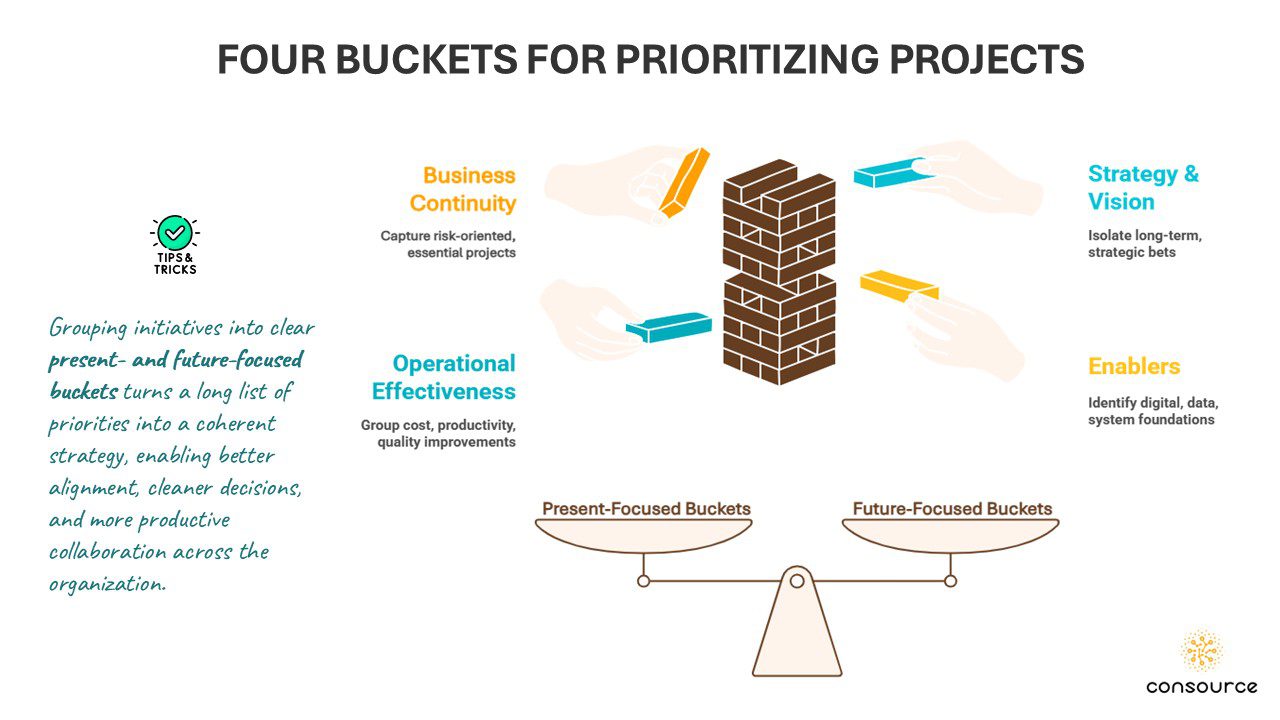
- Business Continuity (Present)
Projects that keep the lights on and regulators happy. Risk, resilience, compliance, safety — the unglamorous but essential backbone. - Operational Effectiveness (Present)
Execution upgrades: cost, productivity, quality, process improvements. These projects often fund your transformation — think of them as the engine room. - Strategy & Vision (Future)
Long-term bets: new markets, new business models, strategic repositioning. Your “future-proofing” category. - Enablers (Future)
Digital foundations, data, analytics, systems, governance, culture. The quiet heroes powering everything else.
This framework does more than tidy up your roadmap. It creates a shared language across Strategy, Finance, and Procurement — one that makes prioritization possible and politics less performative.
Where Consource Supports This
This is exactly the kind of structural clarity Consource is built to enable.
With initiative intake, project-level metadata, and configurable categorization, you can slot every request into the right bucket the moment it enters the system — instead of retrofitting it after the fact.
No more “mystery projects” showing up halfway through the year. No more Excel files multiplying like rabbits. Just a single, structured, secure (SOC2 + ISO-certified) portfolio view. To reinforce this portfolio discipline, Consource centralizes all consulting spend into a strategy-aligned management system. This alignment ensures every project request is evaluated consistently, based on impact, priority, and strategic relevance
2.2 Build the Analytical Flow (Your Roadmap’s Reality Check)
Once your portfolio is organized, you can evaluate initiatives with actual strategic logic — not organizational folklore.
A clear five-step flow helps leaders calibrate where consulting adds leverage:
- Assess Resource Allocation
Where are teams and budgets currently focused? What’s overfunded, underfunded, or inexplicably duplicated? - Validate Strategic Clusters
Does the initiative sit in the right bucket — or is someone trying to sneak a pet idea into “Strategy & Vision” for prestige? - Run a Priority Mapping Exercise
Rank initiatives based on impact, urgency, feasibility, and risk. - Confirm Strategic Alignment
Remove zombie projects (“we’ve always done it”) and vanity projects (“someone important likes it”). - Build a Consulting Utilization Strategy
Identify which projects merit external support, which should stay internal, and which can be hybrid.
Where Consource Supports This
This kind of structured evaluation is painful in PowerPoint and impossible in shared drives.
But Consource turns it into a discipline:
- Prioritization fields and scoring frameworks
- Automated dashboards showing resource allocation versus strategy
- Visibility of historical spend, suppliers used, and performance metrics
- Intake workflows that flag projects requiring further validation
It’s strategic rigor without the administrative pain — and without relying on leaders’ memories of “what happened last year.”
2.3 Prioritize Based on Strategic Value & Cash Impact (The Real Sorting Hat)
Not all projects deliver value the same way. Some keep the business running. Some generate cash. Some build the future. And some… well, some exist because no one has had the courage to kill them yet.
A simple two-lens test clarifies where consulting should be invested:
- Strategic Value
Does the initiative move the company toward its long-term goals? - Financial Impact / Cash-Generating Potential
Can it help fund the transformation or deliver tangible ROI?
This produces four types of projects:
- High Strategic + High Cash → Your no-brainers for consulting support
- High Strategic + Low Cash → Important, but sequence them well
- Low Strategic + High Cash → Quick wins that can fund the roadmap
- Low + Low → Archive with extreme prejudice
Where Consource Supports This
Consource doesn’t decide for you — but it gives leaders the data to make smarter calls:
- Project scoring directly tied to budget and strategy
- Spend analytics that show where consulting dollars actually go
- Supplier performance history to assess ROI likelihood
- Visibility across business units to prevent duplication
It’s like finally turning on the lights in a room you’ve been navigating by intuition. Suddenly, prioritization becomes obvious — and defensible.
2.4 From Insights to Action: Building a Balanced Utilization Strategy
Once you’ve mapped, scored, and prioritized, patterns leap out:
- Some buckets are chronically under-resourced.
- Some teams rely on consultants for everything except morale.
- Some initiatives have no business being externalized.
- And some are perfect candidates for acceleration with the right partner.
A balanced utilization strategy ensures consulting support flows where it creates leverage — not where the loudest stakeholder makes noise.
Where Consource Supports This
This is where Consource truly differentiates itself:
- Centralized visibility into the entire initiative portfolio
- Demand management workflows
- Cross-project analytics
- Category management insights
- Supplier intelligence and performance tracking
- And all of it available in one place, not buried across 23 emails and seven spreadsheets
It doesn’t just help you make better decisions — it helps you make them consistently, transparently, and at scale.
3. The Make-or-Buy Decision: Which Projects Should Be Externalized?
Here’s a truth every leader eventually learns the hard way: the question isn’t “Should we hire consultants?” It’s “Should we hire consultants for this?”
Because not every project benefits from external muscle.
Some need consultants like a gourmet kitchen needs a microwave — convenient, but hardly transformative.
Others absolutely demand outside expertise — and failing to externalize them is how timelines slip, quality drops, and internal teams quietly revolt.
This is where the make-or-buy decision comes in. Not as a procurement formality, but as a strategic discipline. And when done well, it’s one of the biggest ROI levers in your consulting toolkit.
Let’s break it down into three lenses:
Externalizability, Externalization Value, and Strategic Value.
Together, they form a rational, repeatable way to decide what should (and shouldn’t) be handled by consultants.
3.1 Externalizability — Can You Even Outsource the Work?
Before asking whether consultants should take the project, ask if they can. Not everything lends itself to external execution.
A project is truly externalizable when:
- Deliverables are clear
“Improve culture” is not a deliverable. “Design and deploy a capability framework across five business units” is. - Deadlines and milestones are firm
External teams thrive when the finish line exists. They struggle when it moves every week. - Uncertainty is manageable
Consultants can handle ambiguity. Existential chaos? Less so. - Internal teams can supervise the work
If no one has the bandwidth (or the interest) to manage consultants, the project is not externalizable — it’s a trap.
Projects that fail this test usually become the consulting equivalent of quicksand: expensive to enter, impossible to escape.
Where Consource Supports This
Consource’s intake engine and scoping templates force clarity from day one.
Project owners must articulate deliverables, constraints, timelines, and required capabilities before a request even moves forward.
This turns “vague ambition” into “structured scope” — or reveals that the project needs to stay internal until it matures.
3.2 Externalization Value — Should You Outsource the Work?
Even if consultants can take the project, the next question is whether they add value — real value.
Ask yourself:
- Does the project require a skill we don’t have (and shouldn’t build)?
Think pricing science, market entry modeling, deep due diligence. - Will outsourcing improve speed, quality, or cost?
If internal teams can deliver faster and cheaper, externalizing is a downgrade. - Is objectivity required?
Sensitive org redesigns. Strategic repositioning. Anything involving senior egos. - Do we lack tools, data, or methodologies?
Consultants bring accelerators — sometimes the difference between 6 weeks and 6 months. - Is the external provider credible?
Not every “boutique specialist” is a boutique specialist.
Externalization value is where many organizations overestimate what consultants bring — or underestimate what internal teams could do with the right support.
Where Consource Supports This
Consource brings transparency to the equation:
- Supplier profiles
- Past performance
- Rates, benchmarks, and project outcomes
- Category insights
- Internal vs. external cost comparison
With a few clicks, leaders can see whether outsourcing is justified — and which suppliers are likely to deliver strong ROI. Consource strengthens this evaluation through its Supplier Intelligence Engine. By comparing firms on capability, rates, and past performance, teams can select the right partner with confidence and reduce decision risk.
3.3 Strategic Value — Is the Work Important Enough to Justify Consultants?
Some projects are externalizable. Some could benefit from consultants.
But only high-strategic-value projects earn the right to consume scarce consulting budget.
Evaluate each initiative by asking:
- Does this project directly support our strategic priorities?
- Is the timing right, or should we sequence it later?
- Will the competencies gained matter again?
- Is the impact material or marginal?
A surprising number of “urgent” consulting requests evaporate under this lens.
Not everything with a sponsor is strategic. Not everything with a slide deck deserves external budget.
Where Consource Supports This
This is where Consource’s portfolio view becomes invaluable.
Because every project sits within strategic clusters (the four buckets), leaders can instantly see:
- Which clusters absorb the most consulting spend
- Whether spend aligns with strategic priorities
- Where low-strategic-value work is cannibalizing the budget
- How decisions compare across business units
It brings a level of strategic discipline that spreadsheets simply cannot enforce.
3.4 Bringing It Together: The Make-or-Buy Matrix
Once you evaluate projects across the three lenses — Externalizability, Externalization Value, and Strategic Value — the decision becomes refreshingly clear:
- High Strategic + High Externalization Value → Externalize
- High Strategic + Low Externalization Value → Keep Internal or Hybrid
- Low Strategic + High Externalization Value → Defer or Downsize
- Low Strategic + Low Externalization Value → Kill (politely)
This isn’t procurement theater.
It’s disciplined investment.
The goal is not to minimize consulting spend — it’s to maximize consulting ROI by funding the projects where external expertise genuinely moves the business forward.
Where Consource Supports This (Subtly but Powerfully)
Consource operationalizes the entire decision logic:
- Structured intake and scoping
- Framework-driven evaluations
- Centralized supplier intelligence
- Project-level performance history
- Spend and prioritization dashboards
It transforms the make-or-buy process from “a debate” into “a system.”
4. Leverage Quick-Win, Cash-Flow Projects to Fund Strategy
If consulting budgets were bottomless, we wouldn’t need this playbook — or, frankly, consultants. But in the real world, strategy leaders face a paradox: the most strategic initiatives are often the hardest to fund. They’re long-term, complex, and politically delicate. They don’t promise immediate payback, and the CFO understandably wants ROI yesterday.
So you need a different engine — one that generates the cash to finance your future.
Enter the humble “quick-win” project: the unsung hero of transformation and one of the smartest ways to maximize consulting ROI.
Quick wins are not glamorous. No one brags at conferences about renegotiating IT licensing or optimizing tail spend. But these projects produce something that strategy desperately needs: oxygen. And oxygen, in corporate terms, is cash.
4.1 Why Some Projects Aren’t Strategic — But Are Fantastic Cash Generators
Quick-win projects typically sit in the Operational Effectiveness or Business Continuity buckets of your portfolio. They might not redefine your company’s place in the world, but they deliver measurable financial results fast.
Classic examples include:
- Procurement optimization
- Indirect cost reduction
- Working capital improvement
- Price realization
- Supply chain efficiency gains
- IT service or vendor renegotiation
- Process redesign with clear cost or time savings
What makes them attractive for consulting?
They have:
- Clear deliverables
- Strong externalizability
- High externalization value (consultants often have the benchmarks and playbooks)
- Low political drama
- Fast payback
Think of them as the “revenue team” that funds the “strategy team.”
4.2 The Fund-Then-Transform Sequencing Logic
Smart leaders use these projects as a flywheel.
The sequence looks like this:
- Start with quick wins
Choose initiatives with clear ROI and high externalization value. - Generate measurable savings in 3–6 months
Consultants love these projects because they can deliver impact fast — and prove their value. - Reinvest the savings
Shift the newfound budget toward high-strategic-value initiatives that previously had no funding. - Activate strategic priorities
Now you can launch your Strategy & Vision and Enabler projects with proper support.
It’s the corporate equivalent of using operational success to fund innovation.
Without it, many strategy roadmaps remain PowerPoint dreams.
4.3 Internal Alignment and the Politics of Funding
Let’s be honest: budgets are not won with spreadsheets alone.
Quick-win projects do more than finance strategy — they build credibility.
- The CFO sees tangible ROI.
- The CPO demonstrates influence and discipline.
- Strategy leaders gain political capital.
- The transformation office earns a reputation for delivery, not ambition.
This internal goodwill is often more valuable than the savings themselves.
Once you prove that consulting spend can generate returns (and isn’t just “buying slides”), decision-makers loosen constraints — and the organization moves from scarcity to investment.
4.4 Where Consource Creates Leverage
Here’s where digital intelligence quietly transforms the game.
Consource supports this “fund-then-transform” model in three key ways:
- Identifying the Quick-Win Candidates
Spend analytics and supplier performance dashboards highlight:
- Cost categories ripe for optimization
- Recurring inefficiencies
- High-potential sourcing opportunities
- Supplier gaps that specialists can fill
You’re not guessing where the savings are — you’re seeing them.
- Finding the Right External Partners
Consource centralizes supplier intelligence, including:
- Pricing benchmarks
- Capability tags
- Success metrics
- Past project outcomes
Which means you can identify the boutique or specialist firm most likely to deliver fast ROI — instead of defaulting to the usual suspects.
- Tracking Savings, Impact, and Value Delivery
With Consource’s project tracking, performance scoring, and category dashboards, you can:
- Compare estimated vs. realized savings
- Track ROI at the engagement level
- Report value delivered to finance and leadership
- Justify reinvestment into strategic initiatives
It turns the “quick-win flywheel” into a repeatable system, not a lucky break.
And because the platform is SOC2 and ISO certified, leaders can trust the integrity of the data driving these decisions.
4.5 Quick Wins Aren’t a Detour — They’re a Launchpad
One of the biggest misconceptions in transformation is that operational projects distract from strategy. In reality, operational wins enable strategy.
Quick-win initiatives give you:
- Cash
- Momentum
- Credibility
- Data
- Organizational alignment
They’re not the side quest. They’re the fuel.
And when paired with smart consulting utilization and digital orchestration, they create the budgetary runway for the bold, future-defining work your leadership team actually wants to deliver.
Quick wins give you oxygen, but oxygen alone doesn’t build muscle. To truly maximize consulting ROI, leaders must reimagine how they source expertise — not just when they use it.
5. Operationalizing Strategic Consulting Utilization
By now, you’ve built the frameworks, and pressure-tested your portfolio. You’ve separated the high-value initiatives from the noise, matched the right delivery models to the right problems, and identified where external expertise can genuinely move the needle.
Great.
Now comes the part that sinks most organizations: doing this consistently.
Smart consulting utilization isn’t a workshop.
It’s a system.
And unless you operationalize it — embedding it into planning, budgeting, sourcing, and performance management — it will evaporate faster than a strategy deck after the offsite.
Here’s how high-performing organizations make the discipline stick.
5.1 Integrate Consulting into Planning & Budgeting (Not as an Afterthought)
In many companies, consulting enters the conversation far too late — usually right after a project team realizes they’re drowning and someone whispers, “Maybe we should get help?”
That approach guarantees three outcomes: higher costs, lower ROI, and universal frustration.
Instead, consulting needs to be wired into:
- Annual strategic planning: Which initiatives require external support?
- Budget cycles: Where is external spend justified by impact?
- Resource planning: What skills exist internally vs. externally?
- Portfolio reviews: Are consulting dollars aligned with priorities?
This turns external support into a strategic lever, not a rescue mission.
Where Consource Helps
Consource bakes this discipline directly into your intake and planning workflows:
- Every project request includes scope, resourcing, and external-support rationale
- Category dashboards show where consulting spend actually flows
- Strategic alignment becomes visible, not assumed
In other words: consulting becomes integrated into planning, not appended to panic.
5.2 Create Lightweight Intake & Approval Workflows (Governed Autonomy)
Procurement and Finance want control.
Business units want speed.
Strategy wants coherence.
And no one wants another 14-step approval process.
The answer is not stricter governance — it’s smarter governance.
The best organizations build lightweight workflows that:
- Capture demand with just enough structure
- Suggest the right sourcing model automatically
- Trigger template-based processes (RFPs, negotiations, contracting)
- Offer guided autonomy for small or low-risk engagements
- Ensure compliance without slowing teams down
The result is a happy middle ground: teams stay agile, but with guardrails that prevent tail-spend chaos.
Where Consource Helps
Consource was designed specifically for this balance:
- Intake workflows route projects based on spend, risk, and category
- Pre-built templates ensure quality without overhead
- Approvals adjust automatically based on project type and value
- Suppliers can be engaged quickly through curated panels
It’s governance without choke points — the dream of every CPO. And every business unit. And definitely every CFO.
5.3 Build Visibility with Dashboards and KPIs (Because You Can’t Manage the Dark)
If you don’t have visibility over your consulting spend, performance, and project outcomes, you don’t have a consulting strategy. You have anecdotes. And anecdotes make terrible governance.
The KPIs that matter are simple:
- Spend by business unit / function / project type
- Supplier performance (quality, delivery, satisfaction)
- Project ROI (savings, impact, outcomes delivered)
- Utilization patterns (who uses consultants, how often, for what)
- Budget vs. actuals (always fun in Q4)
The goal isn’t control — it’s insight.
Good dashboards don’t punish teams. They empower leaders.
Where Consource Helps
This is where Consource arguably delivers its highest value:
- Real-time dashboards
- Portfolio-level views
- Supplier scorecards
- Performance and value tracking
- Spend heatmaps
- Risk markers
- Benchmarking and historical comparisons
Not delivered in “strategic consulting slide format” — but live, interactive, enterprise-grade, and SOC2/ISO-secure.
5.4 Make Governance a Value Enabler, Not a Bottleneck
Governance gets a bad reputation — usually because it’s designed for the comfort of committees, not the reality of execution. But good governance accelerates value by:
- Eliminating misaligned projects early
- Flagging overuse of consultants
- Highlighting recurring high-performing suppliers
- Ensuring fair competition and pricing
- Creating consistency across the organization
Governance is not a brake. It’s traction.
Where Consource Helps
Consource enables governance that is:
- Light-touch
- Evidence-based
- Automated
- Transparent
- Consistent across business units
The platform improves compliance simply by making the right process the easy process. And when the easy process is also the smart one… well, that’s when transformation starts behaving like transformation.
5.5 Build Feedback Loops & Evolve Over Time (Maturity Is a Journey)
A consulting strategy shouldn’t be static. As your teams grow, your capabilities expand, and your organization becomes more “consulting-savvy,” your approach must evolve.
Build feedback loops from:
- Project teams (“did we get value?”)
- Consultants (“was the client ready?”)
- Finance (“did ROI materialize?”)
- Procurement (“are we seeing patterns?”)
Then adjust:
- Supplier panels
- Governance rules
- Delivery model choices
- Training for internal teams
- Budget allocations
- Sourcing playbooks
Mature organizations continuously refine.
Lagging organizations continuously repeat mistakes.
One of these is more expensive.
Where Consource Helps
Consource centralizes and normalizes this feedback:
- Supplier performance reviews
- Project satisfaction scoring
- Engagement retrospectives
- Category-level analytics
- Trend analysis over time
It turns experience into intelligence — and intelligence into better decisions. Every quarter. Every cycle. Every engagement.
5.6 The Result: A System That Runs Itself (Almost)
Operationalizing consulting utilization means:
- Smart demand intake
- Clear prioritization
- Right-sized delivery models
- Efficient sourcing
- Consistent governance
- Performance tracking
- Continuous learning
Most organizations try to enforce this with good intentions and spreadsheets.
High-performing organizations build systems that do it automatically.
And this is where Consource becomes more than a tool — it becomes the operating system for consulting as a strategic investment.
Conclusion — Make Consulting a Strategic Lever, Not a Cost Center
At the end of the day, maximizing consulting ROI isn’t about squeezing day rates or bullying suppliers into “sharpening their pencils.” It’s about discipline. Clarity. And a mindset shift that treats consulting as a strategic investment rather than an episodic spend category.
The organizations that consistently win with consulting aren’t the ones spending the most — they’re the ones allocating the smartest. They build initiative portfolios with purpose. They use external expertise where it multiplies impact, not where it fills political gaps. They fund strategic work with operational wins. They embrace new delivery models. And they operationalize all of it with systems that make good decisions the default, not the exception.
The result is not just better projects.
It’s a stronger strategy.
A more empowered organization.
And a transformation engine that actually runs.
And this is where technology becomes more than an enabler — it becomes an equalizer.
Platforms like Consource, with their unified intake, supplier intelligence, spend analytics, governance workflows, performance tracking, and SOC2/ISO-certified infrastructure, give leaders the transparency and discipline needed to turn consulting from a cloudy expense into a clear value driver. They help organizations stop guessing, stop firefighting, and finally manage consulting with the same rigor they apply to capital investments.
Consulting will always be a powerful lever.
But only if you pull it with intention.
If you’re ready to bring structure, clarity, and ROI discipline to your consulting investments — and finally make consulting behave like the strategic asset it should be — let’s take the next step together.
Ready to transform your consulting strategy?
Book a free walkthrough of Consource and discover how organizations like yours are using our platform to prioritize smarter, source faster, and deliver more value from every consulting dollar.
